Monday, November 03, 2014

The Secret History


The Secret Diary of Desmond Pfeiffer was, in hindsight, a train wreck in waiting. It's easy to imagine another universe where the UPN's - and later the CW's - signature series never made it past its first season. It's hard to see with sixteen year's hindsight, but the first season of Pfeffer was rough - needlessly crass, irreverent, skating very close to sheer offensiveness based solely on its premise. If it hadn't been for surprisingly strong ratings to buoy what was initially a universally panned show, the program may never have survived to a second season.

Even though the network renewed the series, there were still some reservations on the part of the network brass. Series creators Barry Fanaro and Mort Nathan were notoriously problematic, butting heads with the fledgling network's Standards & Practices department many times during the show's first year. The UPN wanted the show, only without the headache of Fanaro & Nathan. The creators were demoted to the permanent rank of Executive Producers, but essentially cut out of the loops regarding all future decisions regarding the show. (Fanaro & Nathan have consistently declined to speak on Pfeiffer since they left the series.)

Enter David Simon. A former journalist who had written the acclaimed book Homicide: A Year on the Killing Streets as well as having produced the book's television adaptation on NBC, the writer found himself in a unique position following the end of Homicide's seven-year run. "I was the most well-loved failure in town," he related to Charlie Rose in a 2009 interview. "I had produced what many considered to be one of the best shows, ever, and six weeks after production wrapped I couldn't get Dominos to take my calls. I'd go to parties where people would line up to shake my hand and tell me how great the show was. I think everyone who watched the show wound up shaking my hand at some point. That respect - sincere respect, don't get me wrong - got me a few meetings, but when people figured out that I was only going to pitch shows in the same vein as Homicide, the offers dried up. Nobody wanted to invest in making another depressing cult show no advertiser would touch."

"I even had a meeting with HBO," Simon explains. "This was after they did OZ - remember OZ? - and they were looking to do more in the way of scripted dramas. At they time they had bought a script off a friend of mine named David Chase - he had this mob drama script called "The Sopranos" that they kept in development hell for a few years. He said they were good people, though, so I went and talked to them. They were nice but they were riding high off Sex in the City and it was obvious they wanted more like that. We parted ways, amicably."

Chase's "The Sopranos" would eventually be freed from HBO and go on to be produced by ABC, where it lasted three years as Jersey Boy, starring Michael Chiklis. But Simon's career changed forever right after his fateful meeting with HBO, at the moment he had almost given up hope. "I had a script treatment for this book I wrote in the late 90s called The Corner - it was going to be a miniseries about crack dealers and addicts in Baltimore. It was the kind of thing that executives get excited about reading, because it's good and they all want Emmys, before they start asking questions like, ' do you think we could get a Wayans brother to play this guy? How are gonna change this to get a happy ending?' I told my manager to stop showing it to people, I was going to give up. I didn't want to go to work on Sex in the City. I knew I could write another book, so I was going to do that. But not a week after I told my guy to stop selling that script, he called me up and told me there was an offer I needed to hear."

Initially wary of any further meeting, particularly at the UPN - a new network with a less than stellar reputation - Simon agreed only to humor his manager. "I thought it'd be another one of those where I listen to people telling me how great Homicide was before they tell me they want me to do something completely different. But it wasn't like that at all. They spent about 30 seconds blowing smoke up my ass, but then they came out and made me the offer."

The offer was simple: with Desmond Pfeiffer the UPN had a semi-popular show with a terrible critical reputation that had just lost its creators. The first season was not a creative success. The ratings were good but not great, and the feeling was that they had nothing to lose. They offered to give the show to Simon wholesale - make him producer and show-runner, with no restrictions. "The feeling at the network at the time," says TV historian Kathleen Olmstead, "was that they had nothing to lose. The controversy had kept the show on the air for the first year, but the prospects of a second year on the same material were not promising. They saw Simon as a man with a critic-proof pedigree who was also at the end of his rope in television. It could have backfired, it could have imploded. But it didn't."

In a 2006 interview with Vanity Fair, Simon recalled the night after he first met the executives at UPN. "On first - hell, second and third blush, it was a stupid idea. It was a suicide mission. It was a terrible idea for a show, and I had never done anything even remotely funny in my career. I told my manager I wanted to turn them down that night, but he asked me to sleep on it. I went back to my hotel room and switched on the TV. It was spring of '99, so everyone was still talking about the damn impeachment. There was something on PBS, a Frontline documentary about it. I wasn't paying any attention at first, just sitting in bed and daydreaming. But after a minute I realized I was looking at the TV, really looking at the drama being replayed from the senate floor, all those senators and congressmen and (Chief Justice) Renquist looking like a Gilbert & Sullivan character. Pure political theater, completely content free, but dressed up to look as if it were the revelation of some great new chapter in American democracy. And then I remembered, really out of the blue - Andrew Johnson had been impeached, too. Right after the Civil War, right after Lincoln's assassination."

Before he knew it, he had pulled out a stack of videotapes from his meeting with the UPN executives earlier that day. "The jokes were bad, but the actors were pretty good. Chi McBride especially, seemed above the material. But it all clicked for me with Dann Florek." Florek, a television veteran with experience on L.A. Law and Law & Order, gave the role of Lincoln a unique gravitas that belied the dirty jokes and cheap innuendo he was forced to sell. "I knew from just a handful of episodes that I could jettison just about everything else on the show, as long as I kept McBride and Florek," Simon continued. "I called the network back first thing in the morning and said yes, I'd take the job."

True to their word, the UPN did not interfere with Simon as he tore the program down to its roots and rebuilt almost from scratch. The only thing left were the sets and the actors. He fired the entire writing staff, replacing them with Homicide veterans and old hands from shows like Taxi and M*A*S*H, writers who had produced the last good sitcoms Simon had enjoyed. "He got a lot of people who hadn't worked in TV for a while," remembers Vince Gilligan, a former producer and writer for The X-FIles and later one of Simon's assistant producers. "We didn't have a lot of money, but he managed to get a lot of people who wanted to do something more interesting than Friends." In addition, the kept a revolving door of historians and consultants on the show, to guarantee historical accuracy.

When The Secret Diary of Desmond Pfeiffer premiered its second season in Fall of 1999, the show instantly became a critical darling. Ratings were stable. Although the show was in no danger of becoming a runaway hit, its respectable showing had vindicated the UPN's gamble. At the following year's Emmy awards, at which the show was nominated for six awards and came home with two (one for Florek's performance as Lincoln, another - the first of many - for Simon as writer), Pfeiffer had been heavily favored to win best comedy. They lost to Will & Grace, but most critics derided the choice. It would not be the show's last trip to the Emmys.

The first two years of Simon's Pfeiffer are now considered some of the most important television of the era. In a period, post-Seinfeld, when most had given up on the sitcom as a viable creative format, Simon had succeeded in making the most unseemly of vessels into a vehicle for creative renewal. The final product had little in common with Friends or Everybody Loves Raymond: Simon's hybrid show more resembled a 30-minute Playhouse 90, with dashes of Norman Lear's All in the Family. It was smart, literate, hyper-verbal, but could still be devastatingly funny.

Simon remembered a visit to the writers room by Lear in the Winter of 2001. "He came down to visit, because he said he was a big fan. Well, obviously, it was a big day. He sat in the corner and watched us bat around some ideas - I think we were trying to write some material about Sherman's March. We were getting to the end of the war by then. He got up and left after about forty minutes, without saying anything at all. I excused myself and ran down the hall after him. I asked him, 'what's the matter? What are we doing wrong?' and he replied, 'Not a thing. I needed to get out of their before I joined in and started giving you free ideas.'"

Ratings were still healthy, but after two years Simon's run they had begun to erode. The show returned to the 2001 Emmys and won the Best Series trophy they had been denied the year before. Florek again won in the Best Actor category, a bittersweet accomplishment since he had two years' running beaten out his costar McBride for the same award.

Given the acclaim, UPN seemed to be in no danger of canceling the show. Nevertheless, industry watchers were surprised when Pfieffer was absent from its Fall 2001 schedule. Although the series remained in production, it had been pushed forward to Winter in favor of game shows. "That was rough," Simon recalls. "There were a couple years where all the networks gutted their scripted programming in favor of game shows and reality shows. Faddish crap. We had a few more months off, is all, because they wanted some Who Wants to be a Millionaire? clone in the slot for Fall sweeps."

Production for Season 4 of Desmond Pfeiffer had only just begun in early September, 2001. The actors had returned for read-throughs and a pile of scripts remained in various stages of development. The 2001-2002 season posed a significant challenge to the creators, even before the events of 9/11. "The show had been dancing around history from the first episode," Olmstead relates." Everyone knew there was only so long the Civil War could continue. It had a conclusion and everyone knew what that conclusion was. The second half of the 2000-2001 season had focused on Lincoln's second election, ending with his inauguration and segueing into where they were supposed to be at the beginning of Season 4 - the last days of the war. The plan - which had been solidified in meetings with executives the preceding spring - was that Lincoln would die during spring sweeps. All the episodes written for Season 4 were building to that. I've read Simon's draft of the original death episode, and I believe they've been circulating online for a while. It was very good, even in outline."

But that script would never see production. Simon woke on the morning of September 11th to the news that the World Trade Center and the Pentagon had been demolished by acts of terror. "The phone was ringing. I didn't want to answer it, it was still really early. I didn't have to be in work until later. But my family was still on the East Coast so they were awake before me . . . finally I answered the phone and they just said, 'David, turn on the damn TV.'"

Like everyone else, Simon spent the day of 9/11 glued to his TV. Work was canceled. Every channel overrode regular scheduled programming in favor of around-the-clock news coverage. But after eight hours of watching the horrible images repeated on an endless loop, Simon turned the TV off and went to work. Three days later he appeared at the empty set. The only other staff were a handful of PAs and technical crew hovering around the TV. He went into his office and started making calls.

"No one was working that week," McBride remembers. "We were scared to leave the house, that's what it was like then. You couldn't get on a plane. Everything was up in the air. So I get a call from David on Friday morning, I'm expecting him to tell me we're postponing the start of filming for at least a little bit. But he says, "no, Chi, you need to come in today. Now. We have to get to work."

"I remember distinctly, we all got there around two or three. None of us were expecting to come into work that day. We had gathered on the main stage, and we were sitting there shuffling our feet and laughing nervously when David came tearing in from his office. He and his assistant were both carrying giant bankers' boxes filled with scripts. He passed them out without saying a word but he didn't need to, we opened the first page and saw exactly what it was. None of slept much for about a week, until it was done."

The scripts, for Simon's hastily written two-parter, completely changed the plan for Season 4. Instead of building slowly to Lincoln's assassination, Simon's new plan began, literally, with the fatal shot. It's one of the most famous opening sequences in television: twenty seconds of darkness and silence, followed a loud gunshot and screams. Then a tiny light slowly becoming larger, a small figure carrying an oil lamp down a darkened hallway. A tap on a door. Rustling of bedclothes. McBride's Pfeiffer peers out of his dark room to see the lady's maid, crying and shaking in the hallway. She utters just three muffled words before the show cuts to the opening credits - "He's been shot!"

The two-parter "Our American Cousin" / "Oh, Captain," broadcast two weeks to the day after the attacks, was immediately hailed as one of the most significant television programs in history. UPN had been ignorant of Simon's intentions practically until the day he delivered the finished episodes to the network. "It was a complete surprise when he walked in with those shows," remembers an executive who was present when Simon presented the episodes. "Everyone was still in the doldrums, we were all still panicked and running news and repeats. He walks in the room, puts the tape down, and just says, 'we're running this.' We didn't even know he had been working. I called everyone down the hall, put the tape in the machine, and I swear no one in that room, a room full of TV executives and advertisers and secretaries and interns, no one said a word for 45 damn minutes. But when the show was over we were all crying."

The Season 4 premiere of The Secret Diary of Desmond Pfeiffer became the highest rated scripted program for the 2001-2002 season. Although the audience was small the first night, due to the lack of advertising, it was already being hailed in the papers on the morning of September 26th as an instant classic. A rebroadcast later in the week octupled the original's ratings.

Pfeiffer had made the jump from being a critics' darling to becoming a touchstone for American media. Teachers started showing the episodes in history classes across the nation, in reference to both the Lincoln Assassination and the September 11th attacks. Simon's stroke of genius - using our great-great-great-grandfather's national trauma as a means of better understanding our own contemporary trauma - earned him another Emmy, as well as a personal compliment from none other than the President of the United States. His relationship with George W. Bush would not, however, remain so cordial.

The one person seemingly left behind by the making of "Our American Cousin" / "Oh, Captain" was Lincoln himself, Dann Florek. Although he had known all along that his work as Lincoln had a set expiration date, he had expected a full season to prepare for his death scene. Although he was disappointed by the contents of the episode - beginning, as it does, moments after the President is shot - he made one more appearance, in the final minutes of "Oh, Captain," appearing before Pfeiffer's as a ghost to reassure his long-suffering friend. Florek's last words as Lincoln, before fading away forever, quickly entered the lexicon alongside some of TV's greatest quotes:
Although we suffer now, we do so with the understanding that suffering and patience are the great materials by which we construct our character, both as a nation and as a people. It is easy to strike in vengeance, but it is difficult to do so without destroying yourself. A sacrifice made in the name of perpetual strife is a sacrifice made in vain. It is most difficult to show mercy in triumph, but you must. You simply must.
The show retained its place atop the ratings for many years. As the contemporary news continued to report catastrophe and paranoia, in the midst of rising calls for wars, Pfeiffer set about to tell the tragic story of Reconstruction with a candor and violence that would have been unimaginable just a few years earlier. Just as the second President Bush led the United States into ill-fated foreign wars, Pfeiffer methodically showed the failure of Reconstruction to effect permanent change in a war-torn region.

Simon had never made a secret of his antipathy towards the president, but Season 7 became the moment of the show's fiercest critique. Although Simon had initially imagined the Johnson impeachment as a corollary to the absurd Clinton impeachment, circumstances had changed significantly by 2005. According to Hendrik Hertzberg, writing for The New Yorker, "The impeachment of Andrew Johnson has become, for David Simon, a dry run for the hypothetical impeachment of George W. Bush. In Johnson's betrayal of Lincoln's spirit of emancipation, Simon see's Bush's failure to use the 9/11 tragedy as anything more than a malicious, partisan power grab. All the anger, all the righteous indignation over the Iraq and Afghan wars, came out in the unlikely vehicle of a half-hour television sitcom. Although, it must be noted, Pfeiffer long ago gave up any pretense of being a comedy." Under Simon's pen, both Bush and Johnson were callow pretenders, promoted by accident of history to the most important job at the worst possible moment, figureheads completely unprepared - or unwilling - to exert themselves positively in a moment of unparalleled crisis.

Although Pfeiffer had remained strong in the ratings since 2001, the show's increasing politicization in the final years of the Bush administration began to erode its audience. After Johnson's impeachment, McBride's Pfeiffer left Washington altogether, resigning from his hard-won appointment in the gutted Freedman's Bureau in favor of an low-level appointment in the Department of the Interior. With the events of the Grant administration set in the background (although not altogether ignored), the next few seasons of Pfeiffer stepped back from politics and focused on post-Civil War industrialization across the country, particularly the systemic corruption at the heart of the newly-constructed intercontinental railroad line. A much-heralded storyline in Season 9 focused on the connections between the abuse of Chinese immigrant railroad workers and the corrupt regulatory environment that encouraged their exploitation, with a focus on the mechanics of the late nineteenth century opium trade, returning Simon to the subject matter of his aborted script for The Corner. Although critics continued to laud the show for its consistency, ratings continued to drop as the subject matter became increasingly esoteric.

In 2009, ten years after receiving the offer to take charge of the sitcom, Simon stepped down. In his place, the CW (the network formed in the mid 2000s from the combination of the UPN and WB networks) appointed Matthew Weiner. Weiner had worked with David Chase on Jersey Boy before coming joining the Pfeiffer crew as head writer under Simon in 2007. All eyes were on Weiner to fail in Simon's wake: given the cultural prominence of Simon's Pfeiffer, Weiner faced universal skepticism.

"I didn't want the job," Weiner told The Atlantic in 2013. "It was a poisoned chalice. David Simon may not have created The Secret Diary of Desmond Pfeiffer, but in any every way that mattered it was his baby. He had turned it into something special. I didn't think anyone should take it over. Simon came to my office - that was interesting in itself, I usually went to him - he came into my office and told me that he and the network had agreed his time on the show was done. The first thing I asked him was if he had any ideas for a final episode. He shook his head and said, no, they want it to continue."

"I laughed and told him I was quitting, and that I didn't think anyone else would stick around either if they were throwing him under the bus like that. But then he said, no, Matt, no. They want you to do it, and I want you to do it too."

With Simon's advice still ringing in his ears - "make it your own" - he planned a radical departure. The years since Pfeiffer had left Washington had been creatively fertile, but the lack of geographic focus has perhaps alienated an audience accustomed to a stable supporting cast and consistent setting. At the beginning of Season 12, Pfeiffer retired from government work to life in New York City in the mid-1870s, during the Grant administration and the waning days of Reconstruction. After years in government service, Pfeiffer had managed to amass a significant amount of money, so he settled into a semi-retirement as a businessman and real estate speculator.

"One of the great shames of Reconstruction," Weiner said, "and this isn't just in the South but across the country, is that during that period there really was a fair amount of success in the black community as a result of some of Lincoln's policies, many of which were eventually reversed by Johnson, before evaporating entirely. So we had a small black middle-class coming into its own for the first time. Pfeiffer was a man of the world, a British national who had served the US government for almost fifteen years. So wouldn't it be interesting to see what happened to someone like Pfeiffer in this environment, in a place - late nineteenth century New York - where there was a lot of money to be made?"

Weiner's Pfeiffer became a sumptuous period piece, a close look at a small group of what would eventually become Manhattan's richest families in the years just before the height of the Gilded Age. Set down in this milieu was Pfeiffer, consistently underrated because of the color of his skin but nevertheless managing to become a rich man in his own right through judicious investments. Weiner's soft relaunch was well-timed: the next year would see the arrival of the massively successful British import, Downton Abbey, an arrival that catalyzed a new fascination with fin de siecle period drama for American audiences. The CW had again gambled wisely: Weiner's shift from the overtly political tone of Simon's run was a perfect fit for an audience who returned to Pfeiffer looking for a period drama that critics hailed as a perfect mating of Edith Wharton and Charles Chesnutt.

If Simon's later years had focused almost exclusively on Pfeiffer's character as he traveled across the country, Weiner's era introduced a new large ensemble cast. The primary action of the thirteenth and fourteenth seasons was the conflict between Pfeiffer's American cousin Terrence (played by another Jersey Boy alumnus Michael K. Williams) and the enigmatic Don DuRapier, played by Jesse Williams. "I think audiences respond to Don's character because we all relate to mysteries," Simon asserts. "We introduced this man, extraordinarily competent and suave, with a complete blank slate for a past. People like him, they want to find out more about him. Set him off against Terrance, who at first the audience hates, because of what he does to Desmond's daughter - that's the conflict. Pfeiffer's inability to keep these two powerful, willful people from colliding is the tragedy of his later life." Pfeiffer was once again a hit. The climax of the Terrence / Don war, "Indian Summer," saw the series' highest ratings since 2001. The revelation that Don DuRapier was not in reality a white businessman from Pennsylvania but an African-American former slave from Maryland who had stole a white man's identity during the Civil War and had successfully "passed" in business and society circles since 1865 won the show another Best Series Emmy, its first in six years. "We have a responsibility to history," Weiner said during his acceptance speech at that year's ceremony, "Desmond Pfeiffer is one of the great American stories because it has never been afraid to show us ourselves at our best and at our worse."


But the show couldn't continue forever. After dodging death multiple times, the CW announced last Spring that Chi McBride had opted not to renew his contract, and that the following season - the show's seventeenth - would be its last. In an interview from earlier this year, Weiner stated, "when Chi told us he wanted to move on - I don't think there was any doubt as to whether or not to continue. This is his show, as much as it was ever David's. Desmond Pfeiffer has been America's conscience for sixteen years now - longer than anyone ever could have guessed. The idea of killing Desmond and continuing with Terrence in his place, or one of the sons - it never even crossed our mind."

But even as the show prepares to take its final bow, the country won't be done with Pfeiffer anytime soon. "When Barack Obama said in 2008 that his favorite TV show was The Secret Diary of Desmond Pfeiffer, it came as a surprise to no one," Olmstead says. "Even given the controversy of the second half of Simon's run, it was still part of the national conversation. Funny thing is, after spending eight years excoriating the Bush administration, people thought that the post-Obama Pfeiffer might be kinder and gentler towards the powers that be. Well, we know that didn't happen, and the funny thing is that whereas during Bush's administration Simon's attacks were seen as largely partisan, by the time he started using Grant's disastrous presidency as a means to criticize what was already becoming an ill-fated, morally corrupt administration in the here and now, people from both sides of the aisle paid attention. Obama regretted having said that in 2008 because he had to eat his words during Simon's last year on the show."

Speaking to the show's impending end, Weiner is characteristically mum. "I have an idea for how it's going to end. I've discussed it with David, actually. He likes it. It might not be the ending people are expecting, but after seventeen years we are bound to disappoint someone."

Wednesday, October 22, 2014

Down and Out in Santa Clarita


Or: How I Spent My Summer Vacation, Part Four


I had always been afraid of Los Angeles. Partly for the same reason I'm afraid of every big city. I don't like driving in cities. The only car accident I've ever been in happened on the freeway in Boston - I was heading out to my ex-wife's place to help her move (or, more correctly, to help with her dogs during the move, because they had been my dogs, long story) and was having a difficult time merging on the freeway. Trying to get over to a left exit lane going over a bridge, I merged into an SUV - or, more to the point, they came up on my blind spot while my turn indicator was blinking - on my left side. The upshot is that the insurance paid for me to have the damage fixed and a rental car. Even though fixing the damage only took two days I kept the rental car for a week and had my transmission replaced. And wouldn't you know the car ran another 80-odd thousand miles with a new transmission, before finally coming to its final resting place on the side of the freeway in Holyoke, MA, right outside the mall.

People are afraid to merge on freeways in Los Angeles. This is a demonstrably true statement. This is especially true if you are from out of town and are not quite sure where your exit is, or whether the exit is going to be on the right or left hand lane of a six lane road, or whether the lane you get into in anticipation of your turn will become an exit-only lane before you reach your exit.

I hate driving in San Francisco for similar although not quite identical reasons. It's not the hills I mind so much - a few of them can be nerve-wracking, but as long as you don't have to try to park, it's not terrible. The problem is the size of the roads. Most of San Francisco is tightly packed in a way comparable to downtown Boston. Just try to get anywhere around the banking district during daytime hours. The western part of the city is more laid back, but the downtown is forbiddingly dense. So even though Los Angeles seems like it should be far more relaxed in terms of spacing and traffic density, again, where you actually want to go is crowded and difficult to navigate. You can cruise around Northridge or Sylmar to your hearts content, but if you get behind the wheel of a car in Burbank or Hollywood, you might as well bid a fond adieu to your peace of mind.

Despite our best efforts, we found ourselves sucked into Los Angeles. After we finally found an apartment - or rather, a room in a house in the north Valley with two other art students, which is precisely the situation we had hoped to avoid - it was necessary to venture forth into the metropolis in order to acquire supplies. Which meant, in practice, we went to Ikea every day for a full week. Not only did we go to the Ikea in Burbank multiple times, but we even drove out to Covina, on a Friday afternoon. There was a mattress sale, but the mattress we wanted was sold out at the Burbank store, so we drove out to the store that did have it. On the way we listened to a lot of Frankie Goes to Hollywood.


She said she didn't know there was so much Frankie Goes to Hollywood in the world. But it seemed appropriate.

Two days before my birthday we had dinner in the Chevys opposite the Ikea in Burbank. It was surprisingly tasty. She ordered a margarita and enjoyed it immensely.

On my own, during the days she was in class, I ventured on my own into Hollywood, to see the Amoeba.


I ended up going back to Amoebas a few times as the visit wore on. It's bigger, I believe, than the San Francisco store, although at a certain point the difference becomes academic. Even multiple-hour visits over multiple days didn't give me enough time to do anything resembling a systematic look, although I was lucky enough to find a pile of bargains and a few things I'd been looking after for quite a while. I picked up this for an exorbitant price, but about as much as I would have paid for import shipping from the UK in any event. Found some Red Krayola. The aforementioned Frankie Goes to Hollywood. Some Darkthrone. An unopened copy of Jellyfish's Bellybutton for $5, which I hadn't heard in well over a decade. She did not care for the Jellyfish. I, however, enjoyed the Jellyfish more than the new New Pornographers, which I also purchased, relatively cheap from the used bin. I need to listen some more, but it's no Twin Cinema.

There's a Jack in the Box across the street from Amoeba and catty-corner from the CNN building that has an unlocked restroom, out of the line of sight of the cashiers. Amoeba is very confident in their "no public restroom" policy, so I imagine we weren't the only ones to take advantage of the foolhardy restroom policy of the Hollywood Jack in the Box.

As the weeks wore on we grew increasingly tired. The bloom had long ago faded off the romance of this particular trip. She was close to being settled in, ensconced in bother her studio and her apartment. We ate at Lucille's Smokehouse Bar-B-Que on my birthday. It was good.

Next: Homecoming


Monday, October 13, 2014

Down and Out in Santa Clarita


Or: How I Spent My Summer Vacation, Part Three


The problem with much of Southern California is that almost everyone in Southern California believes that Southern California is the best place to live in the entire world.

I grew up in California, so I suppose you can call me a California partisan. California public schools do a great job of indoctrinating each student into the belief that there is no place in the world quite as great. I can still remember most of the words to the songs in my fourth grade pageant, the gist of which were that 1) America was the best country in the world, and 2) California was the best part of America because California was the westernmost point in the continental United State.
There will always be a little bit of the west /
To be won /
To be won.
(Looking online, I see that they are still making students perform How the West Was Really Won, despite the fact that it is - in hindsight - quite offensive in every conceivable way short of having fourth graders playact a lynching on stage. But I see it is mainly performed in religious schools, which is hilarious. America is indeed the land supreme.)

California is a wonderful place, but not all parts of California are equally wonderful. There are large swathes of the state that should be cordoned off from human habitation, and the area immediately surrounding Palm Springs is one of these areas.

My aunt and uncle live in Palm Desert. They live in a very nice gated community, with a swimming pool and multiple guest suites offered for our convenience. If you look at a map you will notice that Palm Desert is roughly 150 miles from Santa Clarita. So why were we in Palm Desert? Because we couldn't afford to stay indefinitely at a hotel in Santa Clarita, and Palm Desert was close family with a bed we could borrow. (We did ultimately end up spending a lot of time in hotel rooms as well, do not worry.)

My aunt and uncle own an air conditioning business. As you can imagine, they do pretty well in the middle of the desert. It's a great line to be in. The way the desert works is that you spend all day in air conditioned houses and businesses, and then jump into air conditioned cars to get to other air conditioned houses and businesses as quickly as possible. If you go out, you don't walk. Not only will you dehydrate yourself in very short order (there's no humidity in the desert, and the moisture is sucked right out of your body), but nobody on the roads knows how to deal with pedestrians, so there's a very good chance they'll hit you with their Lexuses. If you walk in a crosswalk they don't really know how to yield. It makes sense: who in their right mind would be walking around in the middle of the day in Palm Desert? Even the homeless people know to be indoors.

With that said, I can't imagine why anyone would ever choose to live there. The mountains are pretty but there are mountains in lots of places. There are casinos, but then again, there are casinos in lots of places as well. Pretty much every luxury or convenience you could ever hope to find can be found in the desert, has been transplanted there . . . the only thing for which you will search in vain is a reason why anyone ever settled there in the first place.

(Maybe it was really nice 100 years ago? Somehow I doubt it.)

Spending time in Palm Desert with my family was quite nice. Relaxing. My aunt's pool is salt water, and if you've never swam in a salt water pool, it will make you swear off chlorine forever. But even then we would have to get up early in the morning to drive the two-and-a-smidge hours across the desert, through San Bernardino county, and into the San Fernando valley, to climb back up the mountains north of the city and reach Santa Clarita. I got used to the drive. It's not a bad drive, mostly a straight shot with only a couple turns. The only time traffic is bad is if you drive back eastwards around rush hour, at which point there's always traffic between Pasadena and Rancho Cucamonga. But traffic or no, it is a long drive, especially to be done back and forth in one day.

Maybe it was just because Palm Desert was a way station, not really our destination but more like an intermittent vacation (in between days and weeks spent in Santa Clarita), but the whole thing never felt quite real. There's no nature in Palm Desert. There are hermetically sealed micro-climate habitats bunched along at regular intervals, and lethal heat between those intervals. If the water supply was cut off or disrupted there would be riots within two days. As soon as the bottled water was all sold, people would realize quite abruptly that they are not supposed to be living there, and that the only thing separating people (many of whom are retirees) from the lethal heat is an edifice of man-made climate control, be it in the form of air conditioning or aqueducts. Without these great feats of civil engineering, humanity would scatter and burn. It's very clean but also bare of anything but manmade structures.

On the morning of her first day of classes at the art school, we woke early in Palm Desert and were on the road with no small alacrity. Right as we left the front door of my aunt's house, we felt raindrops. We looked up and saw the sky was uncharacteristically cloudy. In the time it took us to walk across the front driveway and climb into my car, the few raindrops had turned into many raindrops. By the time we reached the main road which would lead us to the freeway the raindrops had turned into a flood.

We were trapped in traffic. The water rose quite quickly - at first only an inch, then two inches, and in short order every car was submerged up to its axles. The few SUVs who had tried to race ahead of the floodwaters were soon mired as well. We sat in traffic in the flood for an hour as the waters raged around the car. A few vehicles sat in the middle of the road with their blinkers on, stranded. We trudged along at roughly 10 feet a minute.

Finally the rain stopped. A few minutes after the rain stopped the water disappeared. I don't mean to say that it started to drain, I mean that it was gone with as much speed as it had appeared. One moment the roads were flooded, and in just a few more the roads were clear. The shoulders were covered in trash, and more than a few vehicles had run aground or spun out of control on the side of the road. We sat in traffic for an hour, listened to Wowee Zowee all the way through, and I almost fell asleep at the wheel. In my defense, I had not had any caffeine all morning, we were in mostly stopped traffic, and with good reason I had left the house believing that our next stop would be a place that sold caffeinated beverages.

We hit the freeway just a little over an hour after we left my aunt's house, having traversed a mile in that time. The roads were clear, if covered in a fine layer of silt. We had caffeine. She made it to her first day of classes in plenty of time. But was it an omen?

Next: Drinking in LA


Tuesday, October 07, 2014

Down and Out in Santa Clarita


Or: How I Spent My Summer Vacation, Part Two


Foreigners traveling the United States often complain of the homogeneity of American culture. Everywhere you go, they say, you see the same businesses, the same chain restaurants and the same department stores, with little or no variation for local color. Or at least that's what foreign people say in movies and books. I wonder if foreigners now even notice the homogenization. They have Wal-Marts, too, after all.

There are arguments to be made for homogenization, however, and one of them certainly has to do with the way we travel. Traveling is pretty terrible. I hate it and I avoid it wherever possible. Some people look on traveling as an adventure, a chance to get away from the familiar, to experience something different. That's great, really it is, but how often do you get to actually take those types of trips anymore? Most of my traveling consists of driving someplace at a breakneck speed, settling into a hotel room in a state of exhaustion that never seems to dwindle no matter how restful the beds are, and flailing limply in the general direction of whatever services are available nearby for however long I'm there. It's a good thing if the hotel is down the street from the Wal-Mart, because I really don't want to have to worry about navigating the eccentricities of local supermarket chains at two in the morning.

Seen from the highway, most towns are way stations. If they're lucky they get to keep some character on Main St, but from the highway travelers see in this panoply of towns an unerring reflection of their own desiccated enthusiasm. We don't tour the continent, we strap ourselves to shaky metal wagons and barrel down the freeway at eighty miles per hour in the hopes of making the actual sensation of traveling as brief and painless as possible. Maybe there's something good at the other end of the journey. Maybe there are just more in the way of onerous responsibility. As soon as I pull the car out of the driveway I want to go back home.

There's not a lot of local flavor on display in Santa Clarita. The town itself exists only because Los Angeles needed a bedroom in which to build movie lots and plant orange groves. It's not a college town. The college was built in the sixties with money from Disney for the purpose of accommodating the industry's need for professional artists, craftspeople, and musicians - two other schools, the Chouinard Art Institute and the Los Angeles Conservatory of Music, were combined to make the college.

But it's not a college town. The school itself is tiny: one large complex on the hill overlooking I-5 and a number of smaller outbuildings. Whereas a larger school can set the tone for the surrounding community, Santa Clarita is first and foremost a bedroom community for Los Angeles, with all the baggage that entails. Secondly, it's home to a Six Flags franchise. Thirdly, it's a college town. A very distant thirdly.

In the fulness of time Santa Clarita reveals itself as less a real city than a hybrid between rich suburb and tourist town. It's twenty minutes from Hollywood and appears to be filled with people who can afford to live above the Valley, but it's also filled with the cheap franchise motels and restaurants surely popular with harried families visiting the amusement park. It's a vacation destination for the unambitious and a bedroom community for upper-middle-class Los Angelinos. Somewhere in between these layers there's a horde of art students wriggling in the dark like mealworms under a rock.

Does Valencia have a downtown? Anything resembling old settlements? If it does, we didn't see them. We saw, instead, rows of tract housing on one end and ritzy apartment blocks on the other. Townies packed into a number of crappy apartment complexes that were never so shiny as on visiting day. After you sign the lease they no longer restrain the jackals. There's a very nice mall and just about every chain retailer you can imagine, including three Wal-Marts. Only one of these is a 24-hour supercenter, which represents more of an inconvenience than you might expect.

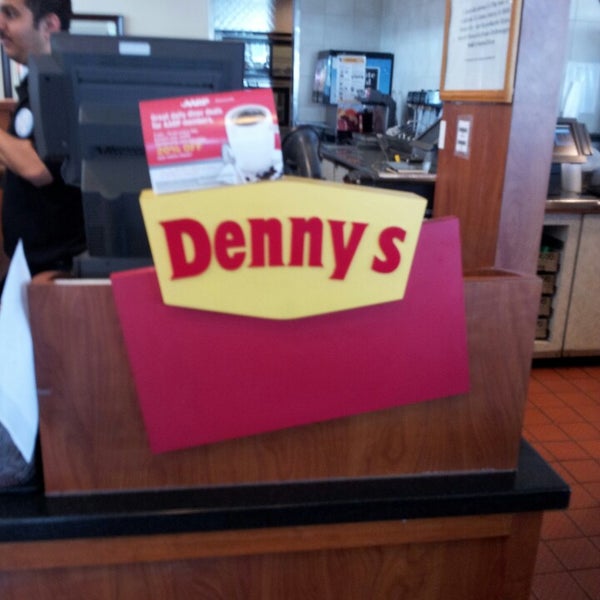
Denny's is a good place to find yourself in moments of insecurity. Eating at Denny's frees you of the burden of having to worry about food. Gone is the anxiety over finding a good place to eat: Denny's is not a good place to eat by any stretch, and that is to its credit. Where it excels is consistency. You can walk into any Denny's in the world at any time of night and be seated at a clean table and receive a bottomless drink of some kind. I always order the same things at Denny's. You don't feel guilty for displaying a lack of adventurousness when ordering dinner at midnight at a Denny's: there's no point. If you're lucky you can find one or things on the menu that you can order with the confidence that, even if they aren't good, they are pleasingly not good in a way that can only be described in terms of comfortable, condescending endearment.

IHOP is Denny's scruffy little brother, always vaguely sticky no matter how well he washes himself. IHOP isn't open all night like Dennys, but IHOP does offer a larger variety of dessert items masquerading as breakfast food. The difference between the food at IHOP and the food at Denny's is that you can't really trick yourself into thinking there's anything worth eating at IHOP in the way you sometimes can at Denny's. For some reason I'll never quite understand, IHOP is always full and Denny's is always empty.

We were in limbo for a month, just over four weeks' time. In that time we drove the road between Santa Clarita and Palm Desert at least ten times, sometimes both ways in one day, sometimes with a night at a hotel in between. There's nothing fun about the road between Santa Clarita and Palm Desert: there's always traffic between Pasadena and Rancho Cucamonga. People in San Bernardino drive like they want to die, and I can relate to that. The only beautiful scenery in the entire trip is the rows of hundreds of electric windmills between Banning and Palm Springs.

People asked, "why aren't you settled? Why are you driving back and forth between Santa Clarita and Palm Desert? Why don't you just have an apartment?" The answers to these questions were all the same: there are no places to live in Santa Clarita. It's not a place people should live at all, really. It's a weigh station halfway between somewhere and another place that just happens to be part of LA County because the shit that went down in Chinatown wasn't really as fictional as you might want to think.

So after a hard day of dealing with college registration and the indignities of apartment hunting, what else is there to do but find a nice secluded booth in Denny's and let the wait staff keep refilling your Diet Coke until you are barely awake enough to shuffle back to the hotel? Who cares if you've probably put on ten pounds since the trip started. You don't care about that. You don't care about anything anymore.

Next: Palm Desert Is Hell On Earth


Monday, October 06, 2014

Down and Out in Santa Clarita


Or: How I Spent My Summer Vacation, Part One


Art school is another country. They do things differently there.

My mistake, in hindsight, was ignoring the warnings. There were certainly plenty of warnings - books and movies, full to the brim with cautionary tales. But how could you believe them? Surely Art School Confidential is satire. There's no way there can really be places like that in the year 2014. With how expensive college is, it was inconceivable that any school could remain so blessedly insulated from the plague of accountability infesting the education industry, from Kindergarten on through the last years of graduate school. As strange and terrible as it can, college at least makes sense . . . right?

I'm an academic, you see. I'm a student and a teacher, and at every level of my career I am cocooned by dozens of layers of bureaucratic obscurantism. I've been in school for the last seven years (just now beginning my eighth) and I've been privileged to attend large land-grant public universities. I really like my job, and I've also come to appreciate all the levels of red tape that protect me on a daily basis - from the whims of instructors, professors, administrators, and students. I had never really thought of red tape in this terms before. I was never so grateful for a functioning bureaucracy as I was after I experienced - second-hand, but still - the registration process at a private arts college.

The school states that they don't want an oppressive bureaucracy interfering with students' freedom to craft their own academic destinies. Some programs graciously list the courses necessary to complete certain programs on time, others do not. You can probably guess which programs are better organized than others: those programs involving computers in some way almost inevitably function in a smoother capacity than those representing the more traditional fine arts. Cultural stereotypes regarding the types of people who like to paint and sculpt and those who manipulate pixels on a screen appear at a glance to be self-fulfilling prophecies. The students involved relish embracing these role-types.

The school has been trying to switch over to online registration for a while now. Much of the registration process is successfully conducted online. But there is a strong constituency who resists the conversion: the professors themselves. So while there are some classes for which the student can register online, there are many others for which the student must report to school on an assigned day and stand in line in large hallways in order to ask certain professors to sign permission slips to register in certain classes. The professors appear to love this.

On the face of it, this is an odd situation. This is how students registered for classes in our grandparents' time, before computers or even the creaky, labyrinthine phone registration systems that were still in place when I first attended college. If you told the professors in my department - any department at a state school like Davis - that they would have to sit at a table in a gymnasium all day signing permission slips to manually register students in their classes, they'd rightfully revolt. But then - I'm talking about professors at a large department who often teach large lecture classes with hundreds of students. A University of California campus serves tens of thousands of students. A small arts college - and regardless of how prestigious (and this is a very prestigious school), we're still talking about a very small campus - has few enough people that they can almost get away with maintaining an archaic system seemingly designed to test the patience of each participant.

The professors like being the center of attention. Scratch that - you aren't supposed to call them professors. They don't receive tenure. In any other university environment, non-tenured instructors are the most conscientious faculty possible. But in art school, the rationale is that the lack of tenure provides (supposedly) greater freedom for artists to practice their craft. In reality, ;ack of tenure does nothing to stop instructors from practicing the kind of behavior that would threaten even a tenured professor's job security. They do things differently in art school.

(And as for those kinds of behavior? You don't need to scratch very deep to hear rumors - rumors which, incidentally, are often immediately confirmed by experience, or a quick Facebook search.)

But it all makes sense, really it does. Graduate school in any field is about professionalization: you should leave the program ready and able to take a job as a working professional in whatever field you've studied, be it English literature or medicine. Obtaining a Masters of Fine Arts is also a kind of professionalization. It's just that the professional expectations of a working artist are radically different from those of a professor, a doctor, a lawyer, or a social worker. You have to become accustomed to dealing with unbalanced people with unvoiced expectations and invisible biases. The same basic social skills that serve you well in the rest of society - punctuality, conscientiousness, courtesy - don't carry the same kind of currency, and in fact can be seen as signs of weakness. You have to project an aura of imperturbability at all times, because that is the means by which you communicate your confidence to the world. Confidence is absolutely necessary, even if - especially if - it's completely fraudulent. Better to say nothing and be assumed wise than to open your mouth and be perceived as weak. Even if everyone in the room has the same question, they will castigate you for having been sufficiently weak to ask.

Art school - studio art school - is designed to train young artists to accept the inherent arbitrariness of the art world. Animators get job fairs, painters get nervous looks.

After the appropriate professors sign the paper indicating that they accept you into their classes, you must obtain another signature from the dean of the school. The Dean of the School of Fine Arts doesn't speak to you, doesn't look at you, merely signs the paper you place in front of him without breaking his conversation. Why did he have to sign the paper if he wasn't even going to look at it? Is there any difference between a man signing a paper he doesn't read and simply eliminating the need to sign the paper?

Once the paper has been signed by the necessary parties, it needs to be taken to the library. The library is where the IT people who are responsible for inputting the information on the papers into the system are located. The librarians aren't pleased with this occupation, and neither are the IT personnel pleased with having to fill out forms for students who could just as easily do it for themselves if the system were automated. No one at all seems happy about having to do this except for the art faculty who get to sit at tables and receive their audiences. It helps, slightly, to commiserate with the computer jockeys: everyone involved sees right through the system's insufficiency, but it nonetheless persists. Certain statements are made implying that the old system is on its way out, and that the process is as awkward as it presently is because the proponents of the old system are doing everything they can to postpone the implementation of a new all-digital registration model. But there don't appear to be any timetables for this changeover.

After a few hours of this, registration is completed (this won't be the last time the schedule needs to be changed, however). Every problem of any kind that occurs within the next few weeks will be blamed by faculty on the difficulties of the new registration system.

Next: Dennys and IHOP are friendly places.