Tuesday, April 22, 2014

Monday Magic


In which Tim explores the world of Magic: The Gathering one
card at a time, courtesy of Gatherer's "Random Card" button.

Wrath of God (Tenth Edition, 2007)


Wrath of God is one of the game's more famous cards. It was first printed all the way back in Alpha and remained a staple of every core set until 2007's Tenth Edition. It does something remarkably simple: it destroys every creature on the table. Creatures with Regeneration cannot be regenerated - but that's not unusual. Regeneration is a useless ability, by and large - its seems as if half of all direct damage cards circumvent Regeneration in some way. And even when you can Regenerate, it's often too expensive to make a difference. I've played on an off for a long time and I can't actually remember ever using Regeneration once.

This is a very good card but it hasn't seen print in a core set or Standard-legal expansion since 2007. I suspect it might owing to the fact that, despite the card's iconic status within the game, it doesn't really fit with what has come to be regarded as white's color identity. To wit: white doesn't destroy. White removal is less violent: the color does not do direct damage. It prefers to exile creatures or banish them to the bottom of the deck - that is, flavorwise, getting rid of the offending creature without actually killing it. White doesn't slaughter. Which shouldn't be taken to mean that white is typically associated with "goodness," but it is associated with self-righteousness and religiosity, both of which can be dangerous under certain circumstances.

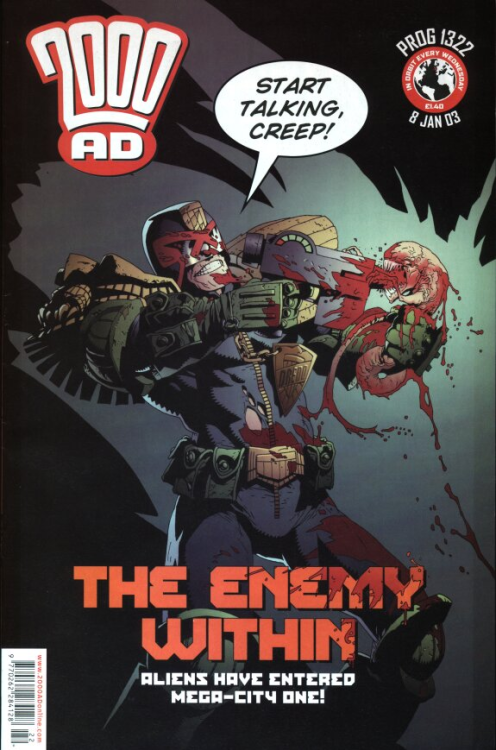
This is not Wrath of God's first art; this was, way back in 1993. The most recent art, introduced in 2001 with Seventh Edition, was produced by Kev Walker. If that name sounds familiar, it should - he's been drawing comics since 1989, beginning his career with 2000 AD:


And then moving on to Marvel, where he is perhaps best known for his lengthy run on Thunderbolts with Jeff Parker:


As well as his run on the controversial Avengers Arena, for which his art was the best part by a country mile:


But he has continued to produce illustrations for Magic, creating a few of the game's most indelible pieces of art.

Geralf's Messenger


Kitchen Finks


Llanowar Elves


Friday, April 18, 2014

SIR


Or, "Hey, didn't this used to be a comics blog?"


X-Force #3


What a strange comic book, reads like someone decided to string a story between random pictures in a Metal Gear Solid game guide.

Thor: God of Thunder #21


I know this should be right up my alley - future Thor with full-on Odin-power throwing down with Galactus on a dying Earth (of course Thor is still completely outclassed, but he's still enough of a shit-talker to make it half a fight) - but I dunno, something about this book is just failing to click with me, even though I've come around to much of Aaron's work on the X-Men books - and the less said about whatever boring shit Thor is up to fighting old Captain Planet villains in the present day the better.

Deadpool vs. Carnage #2


Future Eisner winner, somehow manages to mush together two characters you would have bet money had already fought at some point, but oddly bloodless, which is a reaction I've had to most of Cullen Bunn's Deadpool work - and I'm usually inclined to be charitable to Deadpool based on positive memories of his mid-90s salad days.
Amazing X-Men #6


Remember what I said earlier about Aaron's X-Men - he's doing God's work here, getting back to the business of writing X-Men comics for people who have been reading X-Men comics since at least the Reagan administration, but my question is, what the hell is the point of the Cyclops / Jean Grey School schism if they literally get together for clambakes every week?

Uncanny X-Men #20


This is a book where things seem to happen every issue in random fashion, akin to someone who keeps waiting for the spaghetti to finish cooking and covers the wall with half-cooked pasta in an attempt to make something, anything stick - the best that can be said for it, besides some decent art, is that it's completely not written for the trade, and an argument could be made that the series' free-form nature is a callback to the good old days when every storyline wasn't four or six issues exactly - after all Bendis' Avengers work, it's nice to see him taking some of his Ultimate Spider-Man plotting mojo and at least trying to make his mainstream Marvel work more interesting as long-term narrative - but sadly emphasis still far more strongly on "trying" than "succeeding."

What If . . . ? Age of Ultron #3


Despite an occasionally shaky history, What If...? remains one of my favorite Marvel books of all time - silly me, though, expecting a story advertised as being a "What If...?" relating to the Age of Ultron storyline to be a "What If...?" relating to the Age of Ultron storyline, and not some random Nick Fury / Black Widow vs. a dragon thing.

Ms. Marvel #3


Good book, distinctive and very solid art, really nice character work, let's see how fast it drops down the charts because ew girls and why isn't she hot and the art is lame why not Ed Benes and just wait until someone at Fox News gets ahold of this one.

Superior Spider-Man #31


I hope I'm never too old to appreciate a good Spider-Man story - and after 31 issues, that's exactly what this turned out to be . . . I'm not always impressed with Slott's fixation with the super sci-fi elements of Spider-Man's adventures (always with the new action figure designs, er, costumes), or the constant racheting-up of stakes to the point where Spider-Man isn't always the best fit for his own stories ("Ends of the Earth" was pretty generic, brah), but I'll be damned if he didn't pull this one off, to the point where by the end of the run I realized I had become far more invested than I knew . . . the page where the Green Goblin realizes Peter Parker is back is perfect, and the moment at the end where Peter realizes that Otto had been genuinely trying to become a better person and succeeded at least partially in doing so put an unexpected lump in my throat - how old am I , anyway? - a truly great Spider-Man story will always have some kind of "can't win for losing" hook at the end, and the scene with Anna Maria walking away as Peter realizes what she's lost was up there with the best of them.

Hulk #1


Man was that last run a misfire or what - Mark Bagley's pencils improve so much under the guidance of a decent inker - I do have to question the logic of how the Hulk couldn't heal any injury incurred by Banner, since it's pretty well established that the Hulk has the strongest healing factor on Earth, but I'm guessing we may be going in a "Hulk smart / Banner dumb" direction, so we'll see how it pans out.

Ultimate FF #1


Unlikable versions of characters you like doing vague things in the aftermath of a terrible "event" - and has anyone else pointed out that the way the Ultimates beat Galactus in Cataclysm was stolen wholesale from the last episode of Avengers: Earth's Mightiest Heroes?

X-Men #13


After basically shitting itself for a year, I remain to be convinced it can pull out before completely cratering - but I will admit that I am happy to see the ever-underrated Clay Mann take over pencil duties starting this month - if only the book wasn't still mired in the most boring storyline known to man or God.

Wolverine and the X-Men #3


Someone didn't get the memo that Quentin Quire was a private joke on Morrison's part, and now we're supposed to care about the most hackneyed teen rebel character since James Dean took a bad turn with his Porsche.

Wolverine #4


Surprisingly readable, Paul Cornell is putting in a good attempt to make a Wolverine solo book not seem like the definition of useless - but since this is the middle chapter in an umpty-year long saga, so much will depend on the landing that it's almost silly to predict whether he'll be able to stay the course.

Nova #16


Bland bland bland bland oh it's Cosmo and Beta Ray Bill they're cool but the rest of the book is still bland bland bland bland bland bland bland bland bland bland bland bland bland bland bland bland bland bland bland bland bland bland bland bland bland bland bland bland bland bland bland bland bland bland bland bland bland bland bland bland bland bland bland bland bland bland bland bland bland bland bland bland bland bland bland bland bland bland bland bland bland bland bland bland bland bland bland bland bland bland bland bland bland bland bland bland bland bland bland bland bland bland bland bland bland bland bland bland bland bland bland bland bland bland bland bland like sugar-free Jell-O pudding.

Wednesday, April 09, 2014

Prospective Plots for Season 7 of Mad Men


Don goes to an AA meeting, meets insult comedian Don Rickles.

Roger invests in an aluminum siding firm owned by an army buddy.

Peggy befriends a lonely baby squirrel she finds in the park.

Bert farts loudly in a meeting but no one says anything about it.

Don buys a catamaran.

In California, Pete joins a cult.

Bobby accidentally hangs himself while his family watches the moon landing downstairs.

Roger distributes an extremely detailed homemade newsletter rating the best pizza in New York.

Ted kills a man with his car on the 405.

Someone is leaving mystery cookies on everyone's desk at SC&P.

Chuancey returns, Don adopts him.

After being hospitalized for food poisoning, Joan has a religious vision while under painkillers.

Peggy ghostwrites an episode of The Banana Splits.

Stan breaks his back playing a pick-up game of football. While convalescing at home, he befriends his elderly nurse.

Sally runs away to Hoboken.

Dawn writes a first-person account for Ebony of her experience as a black woman working at SD&P. Realizing they can't fire her, the partners grudgingly promote her.

Joan buys into a time share in Florida.

When an exterminator visits to try to find a rat stuck in the walls, he finds Lane's diary hidden under the floorboards. It's hundreds of pages of drawings of boobs.

Roger accepts an offer to teach a course for NYU's MBA program. He has an affair with a precocious female student.

Don slips and falls on ice outside his apartment, spends the entirety of the season on crutches.

Megan is apparently murdered by a hippie cult in Laurel Canyon. But then she wakes up from a bad dream and AMC runs the phrase "#psych" across the bottom of the screen.

Howard Stark comes to SC&P to solicit a new ad campaign for Stark Industries. Meets Roger in the hallway and they stare uncomfortably at one another for a full minute.

Aliens land in Central Park in the opening moments of the new season and the show becomes science fiction survival horror for the remainder of its run.

Betty "accidentally" stabs Henry in the arm at the dinner table.

Harry's toupee blows off at a baseball game with clients and he comes into the office the next day with a shaved head.

Ted learns to play guitar.

Chauncey returns, conspires with Don to destroy Duck Philips. This is the show's endgame.

Peggy returns from a brief Roman vacation with an Italian husband.

As a result of treatment for chronic diarrhea, Bert becomes addicted to laudanum.

Pete is hired as an extra for the movie Cactus Flower.

The firm hires a new copywriter fresh from a tour in Vietnam. He eats nothing but ice cream and becomes progressively fatter over the course of the season.

Joan is reunited with a long-lost brother.

Peggy receives a mysterious package in the mail containing Oingo Boingo's Dead Man's Party and nothing else.

Trudy lets a hobo move into her garage in exchange for yard work. She does not immediately recognize that the hobo is Paul Kinsey.

Don begins collecting model trains.

Ken buys an expensive suit with his bonus.

Harry quits the firm to accept a job offer from NBC to become an advertising director. He makes twice as much at NBC as he did at SC&P.

In the show's final moments, the show fast-forwards through Bobby's life. We see him become completely estranged from his father. He legally changes his name, goes to college to study chemistry, and moves to the American southwest. After some initial success he leaves the private sector to become a high school chemistry teacher. In the very last scene, he receives a diagnosis of inoperable lung cancer just a day after his 50th birthday.

Pete sees a man in a crowd he thinks he recognizes from college. He follows and cannot find the man.

Betty becomes involved in her neighborhood watch.

Ginsberg gets a Jheri curl.

Don finds a copy of Being and Time in the back of a taxi.

Chauncey returns carrying a litter of puppies in a basket between his teeth. Everyone in the office gets to take one home.

Bob successfully lands the firm a meeting with Mars Candy, but neglects to tell anyone that he's allergic to chocolate.

Sally runs away to the Woodstock festival. Don follows after her, and they reunite in the middle of the field on Monday morning during Jimi Hendrix's performance of "The Star Spangled Banner." Meanwhile, Henry loses in his attempt to convince Governor Nelson Rockefeller to send the National Guard to Yasgur's farm.

Roger begins frequenting the gym at his country club.

While attending a matinee showing of Midnight Cowboy, Peggy trips in the dark and splits her skirt.

Bert is distraught after his favorite deli closes.

While tracking down Midge Daniels based on her last known address, Don is caught up in the Stonewall Riots. He sees Sal behind the police line before being hit in the head by a brick. He awakens confused in the hospital and only answers to the name Dick.

On the day after his 18th birthday, Glen runs into Betty at a gas station near their old neighborhood. They rent a room at a hotel room and he loses his virginity. Later, she packs a suitcase and leaves Henry.

Megan becomes involved with an aspiring director in Los Angeles, but their relationship falls apart after he is hired by the LA office of SC&P to direct commercials.

Ted comes down with insomnia. He begins listening to late night radio in the garage and falls in love with the voice of the graveyard shift DJ on the rock & roll station.

Don is called for secret consultations with Ted Kennedy following the Chappaquiddick accident. Don advises Kennedy against running in 1972.

Gene sees a news report about Charles Manson and begins having terrible nightmares.

Roger is pulled over for a DUI after knocking over a dozen mailboxes on a trip to Long Island. He hires a driver.

Bert becomes convinced that the moon landing is a hoax.

After he falls in love with a female pediatrician he meets at a bar, Pete begins volunteering at the local children's hospital.

Peggy's mother dies and she receives an unexpected inheritance, which after some deliberation she gives to Catholic charities.

Bobby gets his first girlfriend. Betty sabotages their relationship.

Joan and Roger have to spend the night in their car after being caught in a blizzard on the way back from a meeting in Buffalo. Joan confesses that she truly loves Roger but could never marry him because he is inherently undependable, but Roger falls asleep in the middle of the conversation and does not hear her declaration.

Sally insists on going to the city on September 26th in order to buy Abbey Road the day of its release. Don asks her, "didn't we already do a Beatles episode?"

On a vacation in Northern California, Duck is murderered by the Zodiac killer.

Chauncey returns, can now speak. He gathers all the employees of SC&P and proceeds to tell them the meaning of life. Roger breaks down in tears and pledges himself to the service of the Lord.

Don befriends a lost ten-year-old he finds wandering Park Avenue after being separated from his parents. The child is on vacation from St. Louis, MO. After an afternoon of looking, Don reunites the child with his parents and is inspired to quit drinking and turn his life around after seeing the look of joy on the child's face. That child grows up to be famous American author Jonathan Franzen.

Peggy accidentally starts a new dance craze.

Bert romances a widow.

Ted is knocked out in an alley and wakes up in Argentina.

Freddy Rumsen is hired to fill Peggy's old position after her promotion. He quickly becomes fast friends with Jim Cutler, who secretly enjoys attempting to trick Freddy into falling off the wagon.

The final scene is set in the present day. An aged Peggy, accompanied by an unfamiliar man, arrives at the home of the middle-aged Sally. Peggy is welcomed into the house and escorted to a quiet apartment in the rear. In this apartment an elderly Don sits in a wheelchair facing the television. There is an Apple commercial on the television, and Don is scrutinizing the advertisement, although it is unclear whether or not he understands what is happening. After a moment he spots Peggy standing in the doorway. He slowly motions her over to his chair, a vaguely contended smile creasing his parched lips. They embrace. She reaches into her bag and pulls out a book - we see the cover art, a company photo of SCDP circa 1967. The book's title is MAD MEN: MADISON AVENUE IN THE SIXTIES, written by Margaret Olson-Rizzo. Don takes the book in his hands, squints to read the title, and smiles weakly. It is again unclear whether or not he understands the significance of the object. Peggy tells Don that her book has been optioned by a cable network to possibly become a TV show. She motions to the man standing behind her, who steps forward to shake Don's hand. She introduces him as Matthew Weiner, the show's prospective producer. Weiner offers his hand to Don. Don hesitates, then takes the hand. He begins to giggle, at first softly and then uncontrollably. He looks happy. He shakes Weiner's hand vigorously and unleashes a giant shart in his adult diaper. The echo of the blast echoes through the house as the show fades to black.

Chauncey returns. The sky turns red and the moon disappears. Rivers and oceans are clogged with blood. The earth splits and a horde of demons pour forth from the bowels of the earth, killing or torturing every human they meet. The great devil-lord Belial rides a fiery dinosaur through the streets of New York. Chauncey appears before his demon master clutching the limp body of Don Draper in its jaws. Belial impales Don on his satanic trident and cackles with infernal glee as Don stares dully at the fallen angel gloating over his dismemberment. Belial screams, "Through your weakness all men are judged, and through your weakness all men are punished!" The demon horde covers the earth as the Epoch of Man comes to a end. Humanity dies in an orgy of torture, rape, and annihilation.

Betty takes a night class at the local community college.

Monday, April 07, 2014

Monday Magic


In which Tim explores the world of Magic: The Gathering one
card at a time, courtesy of Gatherer's "Random Card" button.

Scryb Sprites (Alpha, 1993)


This is another example of a strange coincidence. Just last week we had another green Faerie from the game's early days - way back when Faeries were primarily in green and not in blue - and this week Gatherer spits up another green Faerie. Most of what I said last week still applies here: Faeries were eventually moved out of green primarily because, with a few small exceptions, green doesn't do flying. In fact, green is the color that dislikes flying the most. Green doesn't have a lot of direct damage or creature removal, except in response to flying creatures.

Other than that, the most interesting thing about this card is simply the fact that it was one of the first Magic cards ever printed. This card hails from Alpha (AKA Limited Edition Alpha), the very first Magic set. Magic premiered at the Origins Game Fair in 1993. The game saw wide release in August of that year. Although Richard Garfield originally believed that the first printing would be sufficient to last a year, the had to return to press in October of 1993 - meaning that Magic sold out of its original print run in two months. People who were around in the game's earliest days describe the release as an overnight panic: one day there was no such thing as Magic, and the next people were driving hundreds of miles between comics and game stores in search of any stock that hadn't already blown out the doors. This is one major reason why quality control was so patchy in the game's first years. The demand for the first collectible card game was unprecedented, and the need for new product trumped the fact that they still barely understood what in the newborn game worked and what didn't.

I didn't start playing - the first time - until 1995, after the release of Fourth Edition. That was the core set on sale at the time I began. Ice Age was released around then, and Homelands was everywhere cheap and plentiful. (For that matter, Homelands is still cheap and plentiful.) I didn't really understand the game very well. I fell in love with the Lord of the Pit / Breeding Pit combination. On paper it's an elegantly simple combo, but in reality the intricacies of the game were simply beyond me, as I usually died well before being able to actually implement the strategy. My dirty secret - well, it's not so secret, since I've mentioned it before - is that I am actually terrible at most games. Even after I returned to Magic a few years back and played regularly (including a number of obsessive Magic Online binges), I just wasn't that good.

Part of this has to do with the fact that I simply refuse to invest the money necessary to be a good player. It's easy to believe - at least for a little bit - that you can still be a competitive player (at least in casual formats) without being willing to drop $100 on a playset of every new Planeswalker. But the reality is that in my experience "casual," at most stores and among many Online players, means something a bit different from what the world "casual" means to most people. You've got people test-driving expensive decks for tournaments, wannabe tournament players, and scrubs. I was and am a scrub. My favorite format was always League, which evens the playing field by restricting each player to a small pool of cards, but also enabling a short-term metagame to develop between different players with vastly different pools of cards. (In theory, I also like Commander, but in practice have never been able to find the time for games that can stretch out to two or three hours.) Since I've been in grad school I haven't had the time to commit to hanging out at a game store (even though there are two in Davis), and I deleted Magic Online off my computer because it enables compulsive and addictive behavior. There is an element of Magic that leans dangerously close to gambling, and for anyone with even a whiff of addictive behavior in their genes (such as myself) it's probably a good idea to avoid the game altogether.

Since the invention of the Mythic rarity in 2008, the game has reached new levels of popularity. It's hard not to see the two developments as connected: Mythic rares appear only 1/8 as often as normal rares, making them even more expensive on the secondary market. The cards printed at Mythic rarity are invariably the best cards in the game. People need to buy more cards now, it's as simple as that. Although the game had encouraged compulsive collecting since the early days (no different from sports cards in that respect), the addition of a higher rarity was like throwing gasoline on a bonfire. If you want to be competitive in most formats, you have to be willing to spend the money to make yourself competitive. No amount of skill can make up for the fact that the person opposite you is much more likely to win if they have four of each Planewalker in their deck. That's too bad, because the game at its heart is one of the best.