Monday, February 10, 2014

Monday Magic


In which Tim explores the world of Magic: The Gathering one
card at a time, courtesy of Gatherer's "Random Card" button.

Ajani's Pridemate (Magic 2011, 2010)


Ah, Ajani's Pridemate. A card I actually play, and a card that I return to fairly often. If you know anything about Magic, you can probably guess what kind of player I am: I am That Guy who loves Lifegain. Meaning, I'm really into non-interactive defensive strategies that win through attrition. Meaning, back when I hung out on MTGO I would get more than a few opponents rage-quitting after saying something to the effect of, "ur decks ghey."

For those of you who don't know Magic, every regular game begins with each player at twenty life. (Different formats change that, but twenty is standard.) Various cards and effects can raise your life total above twenty. It's not always a popular strategy because, as I implied above, Lifegain tends to elongate games and - in extremis - can contribute to static, non-interactive board states that can force a victory by pressing the opponent to concede. Admittedly, it's not fun to be on the other side of the table when your opponent is racking up ten or twenty or fifty extra life per turn and you're stuck swinging for what would under normal circumstances be lethal damage - but if you let me put a stable Lifegain motor on the board and can't deal with my Soul Wardens and Rhox Faithmenders and my Serra Ascendants, well, that's on you, really.

Anyway. I promised last week that I would spend more time talking about the development of story in Magic. This modest card here offers a perfect opportunity to talk about some of the important ways in which the game has changed in the last decade. The name of the card is Ajani's Pridemate, so the first question that should occur to you is, who is Ajani? The short answer is that Ajani is a humanoid lion with a lot of friends who also happen to be cat warriors. The longer answer is that Ajani is a Planeswalker, a powerful new type of card introduced in 2007 in Lorwyn. Planeswalkers are cards that represent powerful beings who you can summon to influence the game.

Magic owes a great deal of its resurgent popularity these past few years to the existence of Planeswalkers. Older fans (and periodically returned fans such as myself) may bewail the cards for being so powerful, for having warped the shape of the game through their ubiquity, and simply for representing perhaps the biggest change in Magic since its inception. But the reason why the Planeswalkers are so important is that they provide the one ingredient that was missing in terms of the game's mass appeal: faces and characters. Oh, sure, Magic had always had characters: they're the creatures on the cards, after all. And there were marquee characters, too, throughout the game's history - important creatures such as Gerrard Capeshan or Nicol Bolas or Teferi who served double-duty as powerful cards and as important players in the game's storyline. But Planeswalkers were different. Instead of being a character who could appear in one or two storylines before the setting changed, Planeswalkers possess the ability to "walk" between the "planes" of Magic's multiverse - thereby participating in long ongoing continuities.

So even though the last few years have seen the game switch settings between the Greek-myth inspired world Theros, a return to the city-planet Ravnica, and the Gothic-horror themed Innistrad - each a separate and distinct plot and play environment - the storyline now allows for a small group of characters to move across these worlds at will, thereby carrying across a larger meta-story from year to year. Since Magic really only gets to tell one major story per year, that means that the storytelling moves at a glacier's pace - we're still waiting to see how Rise of the Eldrazi ended, for instance, even after five years of seeing certain characters recovering from the cataclysmic events of that story.

It was announced last month that they are moving forward with a Magic movie, in the hopes of turning the Magic IP into Fox's Lord of the Rings. (This is especially important now since, you might recall, Disney bought Star Wars, and therefore Fox will never have another new Star Wars movie to distribute.) That this is even within the realm of possibility is due at least partly to the fact that the company has retooled so much of their branding to support popular Planeswalker characters like Jace (their Wolverine, as stupid as it sounds) and Chandra. The game now has faces to go along with it: imagine chess if the bishops were real rude dudes and you might get an idea of what we're talking about here. If making a movie out of Battleship represented the height of idiocy, a Magic movie actually makes a lot of sense: the game already has twenty-years of storylines and a pile of popular characters ready to be plastered onto lunchboxes across the planet.

All of which brings us back to Ajani's Pridemate. Ajani is a powerful Planeswalker, but the problem with Planeswalkers in terms of actual gameplay is that they are very rare. (I haven't discussed rarity yet, so suffice it to say that every Planeswalker card is a hard-to-get chase card.) Even though the characters are the face of the game, it's unlikely that the average amateur player will have much interaction with them. So the characters show up around the game in other ways: here, we see Ajani's friends palling around, here's some more of his buddies, here's his face in the clouds. Even if you never actually lay hands on Ajani himself, you know who he is because he makes his presence felt throughout the game, and then you go buy the t-shirt.

Monday, February 03, 2014

Monday Magic


In which Tim explores the world of Magic: The Gathering one
card at a time, courtesy of Gatherer's "Random Card" button.

Simic Sky Swallower (Dissension, 2006)


One of the problems with Gatherer is that it posts the cards at slightly smaller size than they would be if you were holding it in your hand, which can sometimes make it difficult to ascertain exactly what the art is showing. I found a larger version of the art for this card here, courtesy of some old promo materials. Scary dude.

Last week saw a huge creature from the first Ravnica block, and in a stunning turn of events, this week . . . also features a huge creature from the first Ravnica block. Someone asked me on Twitter last week if I could spend more time talking about how the storylines are developed in Magic, and in particular how a trading-card game can be used as a vehicle for any kind of long-form storytelling. That's a good question, and I realize that so far in this series I haven't discussed the process in itself. So let's discuss it now, keeping in mind this is a big topic that will take time to cover adequately.

The first thing that should be pointed out is that because Magic is such a large game, it has a variety of different types of fans and players. (I won't go into Mark Rosewater's famous "psychographics" theory here, but leave it be said that the game takes its responsibilities to each different type of player very seriously.) Some players are naturally more involved with the competitive aspects of the game, and could be described as either serious duffers or aspiring Tournament players. At the far extreme of this "type" are folks who probably wouldn't be too upset if the cards themselves came without any art or story attached, just stats and rules. But on the far end of the spectrum from these are players who really deeply care about the storyline and know all the intricacies from the game's twenty years' of continuity. These types of players aren't necessarily unserious or noncompetitive - anymore than serious competitors can't be interest in the game's story elements - but these are the two main poles of Magic fandom. (In technical terms, you have "Melvin" and "Vorthos," which aren't really player types but fan types.) What this means is that you're trying to sell the same product to two very different audiences: on the one extreme, highly-competitive math-oriented nerds (if the shoe fits...) who have no vested interest in the game as story; and on the other, fantasy nerds (if the shoe fits...) who love the story, the art, and the characters, but who may even in some instances not even play the game, who might collect the cards for the art, and who have little vested interest in the story as a game. Most players fall somewhere in between these two extremes, but that should give you an idea of the different masters that must be served by each Magic release.

To their credit, this is a tightrope they have gotten very good at walking. The game's early years were split schizophrenically between overpowered sets with less attention paid to story elements and drastically underpowered sets with highly-developed storylines. 1994's ultra-powerful Arabian Nights was the game's first real expansion set, also the only set to take place ostensibly in the "real" world of Earth myths, and also a set without a storyline of its own other than a basic adherence to Arabian myths and culture (they fixed that a few years later when they retroactively grafted a new storyline onto the Arabian Nights setting in a comic, I believe). With a few other single-card exceptions from the game's early years, Magic has stayed far away from Earth since then. But just a year after that Magic also published The Dark, a woefully underpowered set with an overdeveloped storyline and setting.

Cut ahead over ten years to the Ravnica block and you see the product of an extremely sophisticated design and development system wherein both gameplay and storyline are given prominence, and - most importantly - are no longer seen as competing for valuable resources within the world of the game. Ravnica remains one of the game's most popular settings and sets - popular enough on both scores to rate a sequel. The key here is that they figured out how to make story and play compliment each other. From one way of looking at things, Ravnica is a setting built around the mechanical interplay of ten two-color pairs - each possible two-color combination on the five-color wheel that defines the game. The challenge for a designer is to figure out how to make each two-color pair more or less equal in terms of gameplay and mechanical value. But from another way of looking, Ravnica is a giant city world defined by unceasing conflict - in terms of both political and literal warfare - between ten evenly-matched guilds, each guild being in turn a locus of fierce internal strife and dangerous political machinations within its own power base. As the storyline develops the game designers find new ways to reflect the story in the cards themselves - and similarly, as the set's mechanical profile takes shape, the creative team must rise to the challenge of explaining new game elements in the context of the storyline.

All of which brings us back to our friend, Mr. Simic Sky Swallower. This card is blue and green, which means it belongs to the Simic guild. This is an extremely well-designed card because it plays into the mechanical identities of both colors: green (as mentioned last week) is traditionally the color of large creatures, whereas blue is the color of evasion and trickery. Sure enough, the Sky Swallower is a giant beast - technically a "Leviathan" with square 6/6 stats and Trample. But it also has Flying - something that Green, with its focus on giant earthbound creatures, rarely gets, as well as Hexproof (or at least the ability which was later keyworded as Hexproof in a more recent rules update). Hexproof is very powerful, because it means the creature can't be the target of any opponent's spells or abilities - meaning it can't be destroyed by anything but another creature, or a spell or ability that indiscriminately kills multiple creatures without specifically targeting any. Flying creatures can only be blocked by other creatures with Flying, or Reach (an ability that allows creatures without Flying to block Fliers - the ability is often placed on spiders, to give you an idea of how it works). All of which adds up to a giant flying monster that cannot be directly killed and evades most attempts to destroy or control it - definitely in keeping with the Simic's guild philosophy as being the home of "mad scientists" who concoct dangerous and unstable biological hybrids.

Monday, January 27, 2014

Monday Magic


In which Tim explores the world of Magic: The Gathering one
card at a time, courtesy of Gatherer's "Random Card" button.

Autochthon Wurm (Ravnica: City of Guilds, 2005)


Now that's a big-ass creature.

For those of you who may never have touched a Magic card in your life, allow me to explain. I've mentioned previously that the numbers in the bottom right corner of creature are the creature's power and toughness. This means that our friend Autochthon Wurm can do nine damage and can take up to thirteen damage before dying. (Damage disappears at the end of the turn, when the creature "heals," unless you have another effect or ability that causes damage to stick around such as Wither or Infect.) That's huge. The biggest creature in the game (barring the ever-adorable B.F.M.) is the Marit Lage token that Dark Depths creates. The biggest non-token creature (prior to Return to Ravnica, for reasons that will become clear in a moment) is, I believe, our old buddy Emrakul. (My personal policy is that I scoop the moment Emrakul hits the table. I've been able to survive against other Eldrazi, but never Emrakul.) So, even if he's not the biggest monster in the multiverse, he's still pretty awesome. The Trample makes him especially appealing (Trample is an ability that allows the remainder of any damage directed to your opponent's creatures to be carried over to your opponent, instead of only killing the creature in question.)

At first I was confused as to why this creature was multicolored. We haven't seen a multicolored (Gold) card so far in this series, so I'll take a minute to explain: Gold cards are cards that require more than one type of mana to cast - in this instance, two White and three Green. Flavorwise (which means, essentially, conceptually), Gold cards have to draw equally from both (or more) of the colors that comprise their casting cost. (Gold isn't the only type of multicolor card, there are also Hybrid cards, which are - to my mind - a little bit more complicated in terms of design, in that I don't always understand the difference between Gold and multicolored, even though Magic R&D asserts that there is a difference.) White doesn't usually produce giant monsters - White is the color most commonly associated with smaller creature types like Soldiers and Warriors who can gang up en masse, with the most notable exception being Angels, their most prominent and iconic "big" creatures. Green is all about giant monsters - that's more or less Green's defining characteristic, and the Wurm is one of the color's defining creature types. So how does our friend here rate as both a Green and a White creature?

There have been two blocks devoted to exploring the plane of Ravnica: Ravnica: City of Guilds from 2005, and then (naturally) Return to Ravnica in 2012. The gimmick behind Ravnica is that the plane is a giant cityscape dominated by ten guilds - each guild representing a different two-color color combination. The challenge for designing these sets has been the difficulty of creating abilities that satisfy the needs of both colors involved in the guild. Convoke, which we see on Autochthon Wurm, manages to present itself as both a Green and a White mechanic by focusing on the number of creatures you have in play. Both White and Green tend to build strategies around playing many creatures, so the idea of a mechanic that rewards you for doing just that by making it easier to cast otherwise prohibitively expensive spells is a natural in terms of flavor crossover. As I mentioned above, Return to Ravnica printed another 15/15 creature to keep Emrakul company, the impressive - if slightly less psychotic - Worldspine Wurm, undoubtedly a callback to this earlier card. Let me just say, I bet it really sucks to live in a city that's constantly under threat of giant wurm rampages.

The word "autochthon" means that something or someone has emerged, parentless, from the earth itself - "chthon," from the earth, and "auto," self, or itself. The Spartoi of Thebes were supposedly autochthonic because they emerged from the ground after the fields had been sown with dragon's teeth by Cadmus. Similarly, Athens boasted of being an autochthonic nation because they believed that the city and its denizens had never moved or immigrated - hence, a warning to all potential conquerors or rivals that the city and its citizens were firmly rooted and could not be easily defeated. In this instance, however, the Wurm in question is a giant monster who apparently emerges from the depths of the city to fuck shit up. If you can't make it out from the tiny picture, the Wurm is demolishing buildings and completely outclassing the little winged people floating around its head. This is one wurm with whom you do not want to fuck.

Friday, January 24, 2014

Let's Rap With Abhay


When I realized the tenth anniversary of this blog was fast approaching, I tried to think of something special for the occasion. It didn't take me long to realize that in all this time there was one thing I had always wanted to do but had never actually got around to doing: have a conversation with Abhay Khosla. I've never made any secret of the fact that Abhay has always been one of the biggest influences on this blog, one of the inspirations behind me even starting The Hurting to begin with (along with the often-dead-but-sometimes-not Gone & Forgotten). But in all the years I've been doing this, I had never actually had a conversation with Abhay longer than a couple lines here and there. Truth be told, I've always been a little bit intimidated . . . but I've been doing this for ten years, so I felt mildly justified in taking the opportunity to bug him to assent to my prodding.

I would hesitate to call this an "interview" - I talk too much to ever be a good interviewer. Let's say it's a conversation. 

This conversation was conducted online via Google Drive during the week of January 12th.


Monday, January 20, 2014

Monday Magic


In which Tim explores the world of Magic: The Gathering one
card at a time, courtesy of Gatherer's "Random Card" button.

Renewing Touch (Portal Second Age, 1998)


Huh, another Portal card. Statistically speaking, the odds of two cards from the Portal sets popping up within a couple weeks of one another seems small. My challenge for myself in this exercise is to never gin the selection: whichever card comes up when I press the button - with the sole exception of basic lands, for obvious reasons (and if you don't know Magic, well, trust me that it wouldn't make for an interesting column) - I will write about that card. Just in case you were wondering.

Portal, as we discussed last time, was a series of beginner's-only set published in the late nineties. The sets had simplified rules, and the cards themselves had simplified effects. One of the side-effects of this simplification is that a few cards in the set appear to be significantly more powerful than they would have been had they been costed to be played in a normal environment.

Let me unpack that statement for any of you who may be lost. Magic is partly a game of resource management. You start off with the same amount of cards as your opponent (or opponents) and from that point it's a race to see who can build the best defenses or mount the biggest offensive threat. Every spell you cast has to be paid for, and the cost of that spell can be read in the little cartoon symbols in the upper right corner of the card. This is a green card, meaning that the casting cost must be paid in green mana - only one of them in this case. The number of symbols on the card is the amount of mana you need to pay to create the effect - that part, at least, is fairly straightforward. You get mana from lands - to which I alluded above - which can be "tapped" (turned 90 degree clockwise) to produce one mana of the kind that land produces. There are five types of basic lands - Plains (not to be confused with Planes), which produce white mana; Islands, which produce blue; Mountains, which produce red; Swamps, which produce black; and Forests, which produce green.

This is what a forest looks like, although every basic land has hundreds of different versions with different art. They all do the same thing, though.


Since this is a green card that requires one green mana to play, you would need one Forest in order to be able to play it. You can (usually, although there are effects which can change this) play only one land a turn, so it is extremely important to make sure you can place a land every turn, or almost every turn. Since Magic is also a game played with randomized decks, figured out how to ensure you pull sufficient mana can be challenging. For people with more time on their hands than I, figuring this out can even involve math. As much as Magic is a strategy game, there is also a significant amount of luck involved in terms of card draws. Figuring out how to manage and minimize this risk is one of the most challenging aspects of the game.

(Also, it occurs to me to point out at this point in the series that I was / am a terrible Magic player. Even though I know a fair amount about how the game works it's still very hard to implement these ideas effectively, which is why the top-level tournament players compete for many thousands of dollars - you can read all about the money prizes here, in case you think I'm joking. I quit the game again a couple months ago - I had quit in the buildup to my Prelims because I find myself prey to compulsive behavior, especially when I'm procrastinating doing something else - like studying - and having Magic on the computer was too much of a distraction. After my Prelim was done I put the game back on my computer and lost a solid week to it before I took a step back and realized, wait a minute, I don't have the impulse control to properly resist this temptation. So its gone, probably for good, and I don't plan on playing again soon unless I can find time to do it in real life. In case you're wondering, my "replacement" for Magic as something to do when I talk on the phone or watch TV is Civilization - which, um, maybe not the best idea to replace crack cocaine with heroin. Purely a lateral move.)

So, long story short: this is an extremely powerful effect put on an almost comically underpriced card. When creatures die or are otherwise taken out of play, they are put in the graveyard. There are a number of ways to get them back, but usually they require a significant investment. This card, however, just lets you shuffle them all back into your deck in one fell swoop. Say it's late in a long game and you're running a creature-heavy deck. Your opponent has good removal and has maintained a good tempo, so he's been able to effectively parry all your thrusts. Suddenly, whoops, these ten awesome creatures you thought were dead are back in my deck, and I may well pull one of them next turn. And since I'm only putting creatures back, and I've already pulled a significant amount of land and spells that aren't going back in the deck, the odds of me pulling a good creature are a lot better than they were ten turns ago. (Remember what I mentioned about math?)

"Renewing Touch" isn't the only card to have this effect, but it may very well be the cheapest. This is not a card I can see them reprinting in a Standard anytime soon.

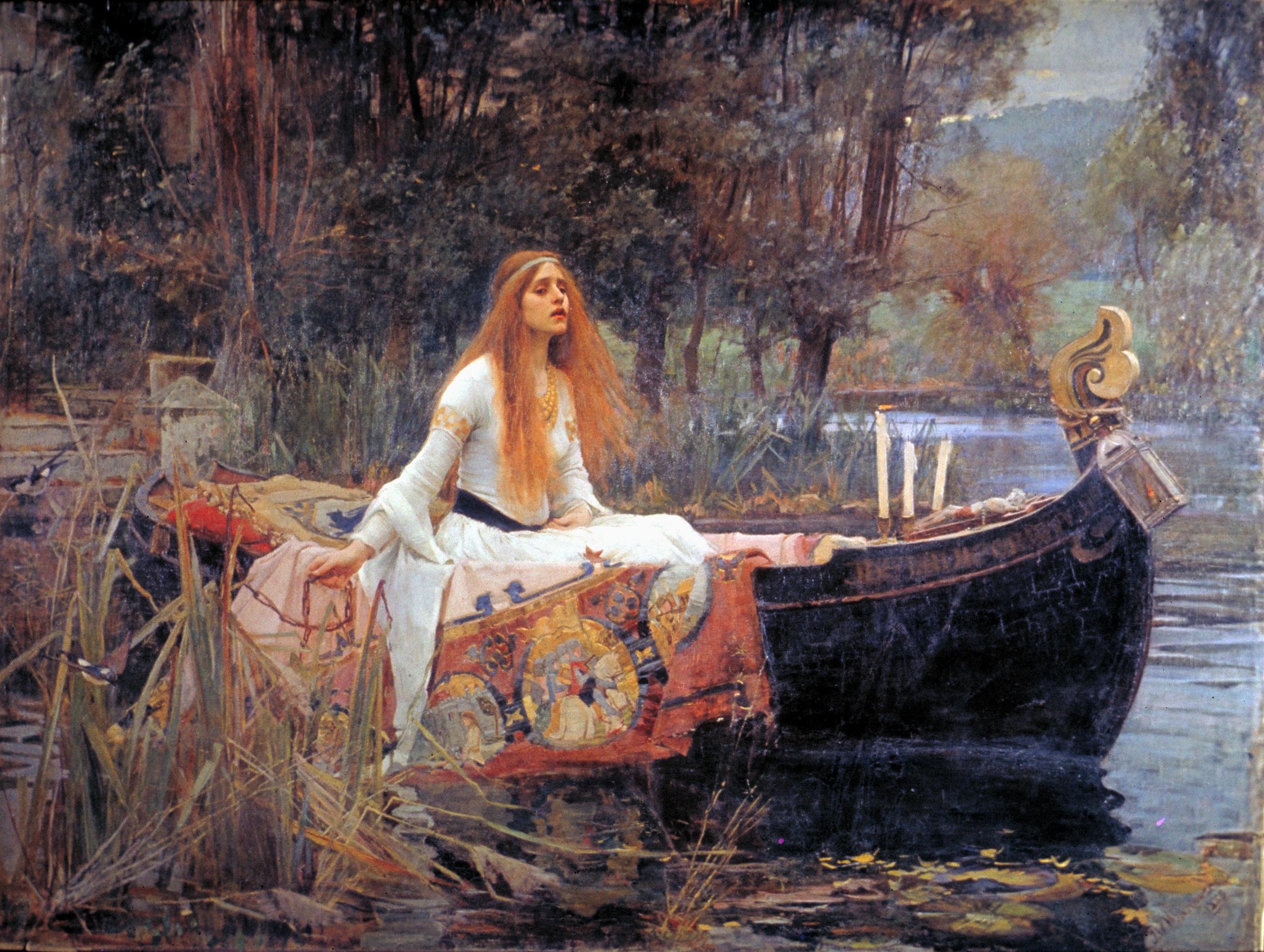
Anyway, the other interesting thing about this card is that the art was produced by Rebecca Guay. She did a lot of art for the game in the last decade, although don't recall seeing her much in the last few years. She is very good, definitely a disciple of the Pre-Raphaelites - you can seen Rossetti and Waterhouse, as well as N. C. Wyeth, although he was too late to qualify as Pre-Raphaelite. (As well as being American.) Looking through her page I especially like this and this. Her more recent gallery work, if her page is any indication, appears to be moving away from the heavy Pre-Raphaelite influence - this could almost pass for Yoshitaka Amano. She is a talented artist and I wouldn't blame here if she had higher aspirations for her art than providing 2"x1.5" illustration for a piece of cardboard.