New remix up here. This one won't make any sense unless you know a fair amount of nerd trivia, so caveat emptor.
Monday, March 21, 2005


Hey, Mister - The Fall Collection
When Top Shelf announced their recent sale, I bought a pile of books that I knew were good for me - some Glenn Dakin, some Tom Hart, a couple anthologies. I also bought the third reprint compilation of Pete Sickman-Garner's Hey Mister series, and hey, guess which one I read first . . .
I don't think I've ever heard anyone else discussing the series, which is a shame. It's funny. Consistently funny. It operates on a slightly lower key than Dork or Angry Youth Comics, which might go a long ways towards explaining its invisibility. It's a lot more subtle than either of the above, and a lot of that has to do with the fact that Sickman-Garner is nowhere near the virtuoso cartoonist that either Evan Dorkin or Johnny Ryan are. His humor depends a lot more on sustained mood and character, not so much on the slapstick or silly, and very rarely on the scatological.
Basically, Hey, Mister is a valentine to squalor. Sickman-Garner's world is a threadbare and depressing place. Every wall is cracked and every piece of plaster is chipped. Even when something is clean it looks limp, washed out with industrial-strength fluorescent lighting and scrubbed by an underpaid immigrant cleaning lady. Enthusiasm doesn't really exist in this world, except for the torpid kind of enthusiasm that comes with screwing over rich people or going to the liquor store.
Sickman-Garner's world is inhabited by three hapless rejects, the titular Mister, the eternally grumpy Aunt Mary and Young Tim. Their relation is never defined, except to say that they aren't blood even though they seem to be perpetually bound together as roommates and companions. Probably because no one else would put up with them. Mister is secretly infatuated with Mary, which is funny because Mary is just surly. They know where they stand on the totem pole of life - at the bottom, with no illusions as to the fact that their existences are pretty much the definition of superfluous. As depressing as it sounds, its all pretty damn funny.
Whatever happens in the course of a Hey, Mister adventure, you can be assured that it will be fairly pitiful. They journey up Jack's beanstalk to find a pig that pees whiskey, only to find the giant passed out in his underwear on the floor. Young Tim gets a job assisting Jesus with the Rapture, only to be damned (literally) because of office politics.
Aunt Mary gets knocked out while working at the Nature's Pantry supermarket, but instead of waking in a wonderful, Technicolor Oz she wakes up in . . . the Nature's Pantry supermarket, with half-a-dozen miniature Tim's dancing around her like Munchkins. Her "fantasy" concludes with a lunch-break in the cafeteria, before waking up back in sordid reality. Eventually, overwhelmed by the stupidity of the world around her, she runs into the countryside in search of peace and contentment. She sits under a tree and plucks an apple from a tree . . . but the apple has a worm.
Every silver lining comes with a cloud in Hey, Mister. Surprisingly, considering the resolutely sordid nature of the adventures, Sickman-Garner actually manages to wrest quite a bit of pathos out of such pitiful situations. Mister, Mary and Tim are essentially decent people turned rotten by the absolute pointlessness of everything around them, and the realization that they are neither beautiful nor rich enough to be allowed access to anything better in life, and too smart to be able to ignore the difference. They don't really expect things to get better, but they still possess the capacity for disappointment. This capacity is perpetually exploited in the pages of Hey, Mister.
By far the highlight of the book is "Dial 'M' For Mister", an updated Pygmalion wherein Mister is adopted by Hera (yes, of the Greek pantheon) in order to fulfill a wager that Aphrodite will sleep with anyone. The only problem is that Mister sees through the gods' vapidity, and ultimately becomes disappointed when faced with the fact that he is unable to have the one thing he truly wants. Of course, there's no such thing as a happy ending in Hey, Mister, and the eventual ironic fulfillment of Mister's greatest desire leads to the book's most inspired moment of comic despair.
Hey, Mister officially counts as a "buried treasure", one of the more sublime examples of farce I've seen in quite some time. Sickman-Garner is a talented humorist who somehow manages to make even the most pathetic situation funny merely by dint of the fact that his characters remain perpetually, disconcertingly familiar.
height="240"
scrolling="no"
marginwidth="0"
marginheight="0"
frameborder="0">
Friday, March 18, 2005
Artforms are defined by their limitations. Literature is limited to words strung together from component alphabets. Music is soundwaves given shape by modulations in tone regulated by temporal frequency. Cinema is composed of a series of pictures projected on a screen (or reflected across a cathode ray tube) at roughly the rate of 24 times a second, creating the illusion of movement.
The definition of comics is something more vague, however. Smarter men than I have tried for quite a while to coin definitions, with mixed results - invariably, every proffered definition excludes something at the expense of wittingly or unwittingly emphasizing something else. Whether it's Scott McCloud kicking Bil Keane out of the cartooning fraternity or R.C. Harvey closing the door on Al Hirschfeld, the rush towards academic certainty is never quite as fulfilling as it may seem on the outset.
Better, then, to define comics by the process of negative exclusion. It's far easier for a group of like-minded individuals to agree on what isn't comics than what is, so better to start there and work backwards. Comics is not cinema, or animation, because comics depend on static images whose relation to each other remains fixed in both time and space. Comics is not "fine" art (i.e. gallery art - let's not get into installation art!), because fine art is usually composed of singular pieces intended to be considered in isolation.
But wait - you say - what about paintings that are conceived as series? If you accept something like Superman #75 as comics (that was the infamous "death" issue composed solely of a series of splash pages), then what about every Renaissance painter who did multiple paintings on the death and resurrection of Jesus? Does that make Ruebens a cartoonist simply because some of his paintings can be "read" in sequence? And if you say that it matters which medium the work is presented in, what about all the painted comics? Some may be better than others, but there can be no denying that both Moonshadow and Kingdom Come are comics. What about "Guernica"?
Er. Um.
This is what happens when you try to define something that is, by necessity, very ambiguous. Best not to bother. People know what a movie is without having to argue about it, for the most part, just as people know what literature is. Sure, they may want to argue over what constitutes a novel and what constitutes a prose poem or novella or villanelle, but at the end of the day you're not going to confuse a book of Shakespeare's verse with a DVD of Othello.
Let us simply assume, for the sake of argument, that anything which we can conceivably consider to be comics is comics. Does this mean we have to actively include every different permutation of form in every single discussion? If I want to talk about Curt Swan and Wayne Boring do I have to name-check the Bayeux Tapestry?
Don't be silly.
The fact is that the moment you try to peg down what is or isn't comics, someone, somewhere will disagree, and point to some form of comics that disproves the theory. If you are too inclusive, you lose the focus that the definition was created to instill.
Comics are a purely visual art - which excludes any sort of music or spoken component. Comics are a static art - meaning no motion or movement on the part of any of the visual components in relation to each other (but not, perhaps, in reference to the reader, or you'd never be allowed to turn a page). But besides those two limitations, that leaves the field pretty wide open.
There are undoubtedly semiotics fans out there who will protest that words and sentences, dependent as they are on the static juxtaposition of symbols to accrue accumulated meaning, are comics as well. It's certainly hard to argue with that kind of logic, but it also seems to be a limited concept for further inquiry. While the letters in any alphabet are essentially arbitrary, their meaning is fixed in the mind of the beholder (assuming said beholder is literate). The actual linguistic content of words and sentences is the medium by which literature gains its power, not any uniquely evocative properties of the letters themselves, which ideally (from the perspective of the writer, who hardly wishes to be upstaged by his typeface!) serve as a value-neutral conceptual vehicle. Of course, lettering in comics can get away with being very evocative, as anyone who has ever read an issue of Cerebus can attest.
So we are left with porous and uncertain boundaries. Comics evolved partly out of the tradition of fine art and illustration, and incorporate many elements of those fields. Likewise with literature - words and literary forms have been inextricably bound with comics since the very beginning. Cinema - including the tradition of animation - sits as well on the borderline of cartooning, incorporating many of the formal and structural attributes of the field while remaining distinctively recognizable.
It's useless to try to pin down what is or even what isn't comics, because that brand of rhetoric has proven to be a tar-baby for any number of qualified theoreticians. Better simply to say that comics is a particularly large and amorphous entity which sits at the borders of multiple different forms. This isn't to say that just because something falls into the "none of the above" category, it's automatically comics, but it at least gives us common ground for our discussions - the negative exclusion creates at least the broad outline of a working definition.
Comics are a liminal medium, a hodgepodge of different elements combined to create allusory meaning greater than the sum of its parts. The thresholds which separate comics from its cousin mediums are crucial to understanding the medium's unique strengths, but should never be mistaken for the entirety of the picture.
Thursday, March 17, 2005
Number One in an Open-Ended Series of Thoughts on the Aesthetics of Comics
If there is one fact that recent discussions have grudgingly revealed to the informed reader, it is that the language and conceptual space which we use to discuss comics is woefully inaccurate and pitifully sparse.
The Comics Journal has recently run two fascinating interviews with individuals working on the exact opposite of the aesthetic spectrum: Ivan Brunetti and Brian Michael Bendis. Both men discussed their craft and the overriding principles behind their body of work, and yet it seemed at times as if they could have been talking about two totally different artforms. True, even under the best of circumstances a high practitioner of ascetic formalism and a prolific popular storyteller would probably have little in common - but it would at least be nice to be able to infer that they share the same medium. The dearth of accessable critical discourse is a crippling handicap towards the medium's broad aesthetic advancement.
I think that the problem rests on the fact that comics is a hybrid medium. Until very recently, whenever comics criticism has popped up, it has taken a hybrid form - by adopting either literary or cinematic lexicons and basically shoehorning the content to fit the language. While it is true that both traditions have much to contribute to our understanding of the medium, it is also true that inexact literary analogies and didactic cinematic correlaries have done a lot to hinder both the critical and popular discourse.
The elephant in the drawing room whenever anyone brings the subject up is Scott McCloud's Understanding Comics - a great book that was also an unmitigated failure in terms of the author's stated goal, i.e. to create an ongoing critical dialogue on comics in the confines of the medium itself. I think the fact is that although McCloud presented a number of interesting ideas in a cogent and thoughtful format, he essentially shot himself in the foot by presenting them in the ostensible guise of a Grand Old Tome, which could either be accepted as absolute truth or rejected as foolish apostasy. Of course he didn't intend such a schism, but it did occur, and as a result anyone who tries to discuss the broad scope of comics critically almost has to dismiss the book entirely before they begin.
But even if you give McCloud the credit for trying to start the dialogue, you are still left with the fact that he didn't do much in the way of exploring the language that needs to be developed before such a discussion can even occur. Too often, any meaningful discussion between professionals devolves into mere craft (and certainly there's a lot of craft masquerading as criticism in UC). Craft is important but ultimately only as a small facet of a larger organism.
Strangely enough, despite the domination of those two fields on the medium, the third obvious contributor, the critical perspective of "fine" art, is almost totally absent from any comics dialogue. This probably says more about the insulated nature of fine art than comics. But that's one less set of baggage - preconceptions, limitations and jargon - that we shall ultimately have to jetison.
I believe that if you conceive comics as merely an annex to literature or an offshoot of cinema, you are criminally unprepared and essetially unqualified to undertake any rigorous discussion of comics aesthetics, craft or history. If you're not ready to discuss comics as comics, you aren't ready to discuss comics, period.
Marvel Super Pages
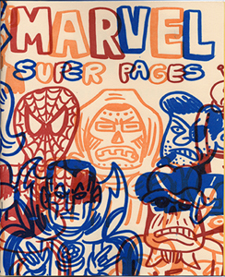
This review owes its existence to my homie Neilalien, without whom I would probably never have known this book existed. If you don't already own a copy you're probably out of luck until someone puts it up on Bittorrent. Only 200 were printed, and judging from the number on the inside cover I got one of the last ones. This at least makes up for me not picking up that copy of Cooper Skeber #2 all those years ago when I saw it in the store . . .
It seems impossible to discuss Johnny Ryan's work without presenting some sort of caveat, but I bristle at the notion that such a talented cartoonist needs any sort of excuse. His chosen subject matter just happens to be graphic scatology and pornographic crudeness. Perhaps the most dismissive thing certain people can find to say about Angry Youth Comics is that it's juvenile, but anyone for whom that is the be-all-and-end-all of put-downs is in actuality just stating a fact. Johnny Ryan is to juvenilia as Crumb is to women with big asses: he elevates a freakish preoccupation into high art. It's OK not to like it if you don't find it to your tastes, but don't dismiss it out of hand.
Scatology has a fine tradition in the comics. Certainly, most children are at some point fascinated by the notion of societal taboos which they do not have the capacity to understand: bodily excretions, sex, death, incest, cannibalism. Oftentimes these preoccupations predate the capacity for language: by the time you know how to write, you don't want to write about poop anymore. So, that's where cartooning comes in - anyone can draw poop. It's easy. Just grab a brown crayon and go to town.
To violate societal norms once is scandalous and profound. To violate such norms twice is merely pique. But to do so repeatedly, and indeed to make such serial inversion into your raison d'etre, remains an unnerringly accurate method of cultural explication. Just look at how well Catch-22 holds up (really well), and look at how shocked people were when Brett Easton Ellis wrote American Psycho just a few short years ago. When it comes to holding an unflattering mirror up to society, nothing succeeds like excess.
Ryan's already-prodigious body of work exists as a necessary bromide to all the self-conscious and explicitely serious cartoonists out there, all the sad-boy caricaturists and the conscientious graphic novelists. Taken singularly his work may not add up to much, but together it becomes powerfully suggestive satire. Which is not to say that poor ol' Loady McGee is ever - God forbid - profound, but the incessant lack of profundity in Loady's adventures creates a definite ironic weltschmerz that sets the work in sharp contrast with some of the more pedantically profound cartoons of our era.
Marvel Super Pages really hasn't a lot to do with the characters involved. All you need to know about Iron Man to enjoy Ryan's take is that the chracter wears a suit of armor and really likes to drink. The Vision is a robot with a pipe wrench for a penis and the Scarlet Witch is an oversexed mutant. Captain America is deeply closeted with a flat-chested Asian girlfriend. You get the idea. if Ryan weren't such a canny caricaturist, it might get old, but he's got an intuitively loose and appealing style which belies the complaint that he can't draw. In another universe he'd be a storyboard artist in the "Golden Age" of animation - his lines are clean and his figures are loose. He’d be the one who drew all the suspiciously-well-drawn Tijuana Bibles in his off-time – stuff like Mickey Mouse and Blondie having anal intercourse. The quiet mastery of craft underscores his canny storytelling, and this is why the endless stream of shit-and-cunt jokes remain so engrossing.
So let us all salute Johnny Ryan, one of our most vital and bold cartoonists. I don't know how long he can keep it up - honestly, there is no telling how long this will remain funny - but until something better comes along I'm just glad to be along for the ride.
UPDATE: It looks as if, against all my expectations, they might still have one or two copies for sale here. Go get ‘em, Tiger.
Wednesday, March 16, 2005
Yes, after all these years of patiently waiting, DC is once again bringing back the greatest emerald ring-slinger in comic-book history. What's that you say? Hal who? Hell no, I'm talking about my main man G'Nort!!!
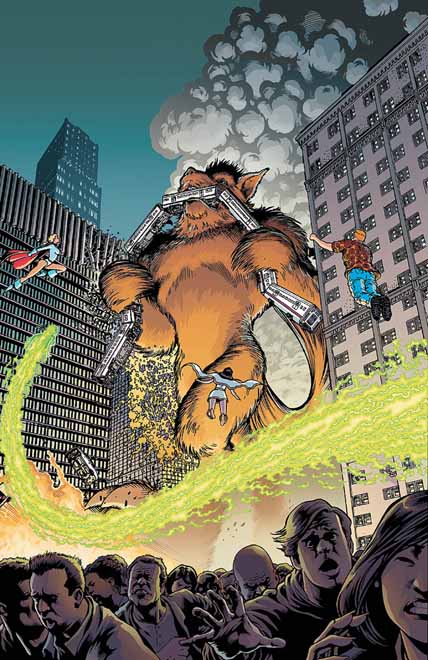
You can take your H.E.A.T. and shove it, pal - around here, we go by G.I.G.G.L.E.:
G'Nort
Is the
Greatest
Green
Lantern
Ever!!!
But seriously - that's not hard, with competition like this:


I mean, are we supposed to take these things seriously? I say, give G'Nort his own damn series - I'd buy five copies, and I think all the hundreds of thousands of G.I.G.G.L.E. members across the world would second that...
Subscribe to:
Posts
(
Atom
)