Pizzeria Kamikaze
by Etgar Keret & Asaf HanukaThe question of just how my reviews are perceived by the people who read this blog is something which I'll admit takes up a bit more of my thinking time than it probably should. I end up writing a lot of positive reviews, and I'd be lying if I said that didn't occasionally worry me, in a weird way. For some odd reason we've got this critical system where a negative review is granted far more weight than a positive one, and a critic's
gravitas is often measured, either directly or indirectly, by the articulate negativity which they can bring to bear on their subjects.
It's all bullshit, of course. But that doesn't mean that the prejudices aren't still there in the back of a person's mind. I worry about whether or not all these positive reviews have the effect of lowering my esteem in the critical community (as if there is such a thing as "esteem" in such a community -
hah!); whether or not a genuine enthusiasm for the subject can be seen by some as a sign of an undiscerning intelligence, a weakly developed aesthetic sense, or just plain old bad taste. There are, of course, much more important things to be worrying about, but you could probably make a good argument for the idea that if I had better things to worry about I wouldn't be blogging in the first place.
Which brings us, in a roundabout way (is there any other kind?) to
Pizzeria Kamikaze, recently published by Alternative Comics. It is pure coincidence that
Pizzeria Kamikaze was next in my to-read pile after
The Placebo Man, despite the fact that the latter was by Tomer Hanuka and the former is the product of his brother, Asaf. Reading both books within the span of just a couple days, I was left with an undeniably disquieting feeling of awe, that two such incredibly talented cartoonists could have come from the same lineage. It's not without precedent, obviously: I'm not going to put the Hanuka brothers up there with Los Bros Hernandez anytime soon. But in all seriousness, if they continue to apply themselves to the medium with the same conscientiousness they have the potential to be among the very best creators of their generation.
Pizzeria Kamikaze is, if anything, even more impressive than
The Placebo Man. Part of the charm of Tomer's volume was seeing the artist come into his talent, emerging from early experiments and misfires into a fully-formed cohesive creative vision. But there's nothing tentative about
Pizzeria Kamikaze. It probably helps in this respect that
Kamikaze is actually an adaptation, in this case of Etgar Keret's novel
Kneller's Happy Campers. I've never read any of Keret's work before, but the promotional material describes him as "the Amos Oz of his generation" - high praise, I suppose (although we can hope that if Keret's work is any good he will find a larger audience outside Israel than Oz has ever managed).
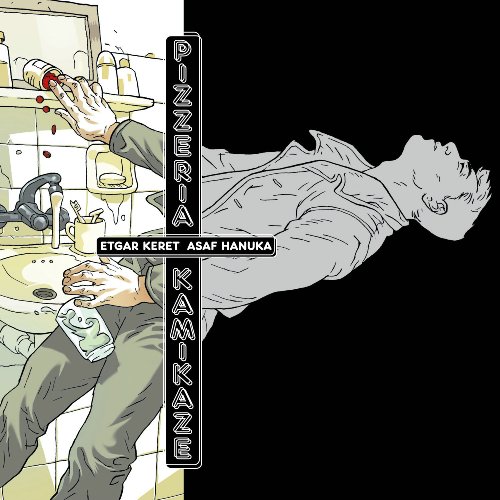
The result is, in any event, one of the most gratifying literary adaptations I've ever seen in the comics medium. The story begins with a suicide, that is, Mordecai's suicide - after which he finds himself working at a pizzeria somewhere in purgatory. Or rather, a purgatory populated exclusively with the ghosts of fellow suicides. It's very much like earth, only maybe a little more drab in places, and people often have conspicuous exit wounds or massive scarring on their wrists. (Mordecai took pills, so he arrives in the afterlife in pristine condition.) After a while shoveling pizzas out of the oven, he runs into an acquaintance who informs him that his girlfriend from earth killed herself not long after Mordecai did, inspiring him to set off across the countryside to find her.
More than anything else,
Pizzeria Kamikaze reminded me of Albert Brooks'
Defending Your Life*. Although the two works are dissimilar in tone -- with
Pizzeria Kamikaze coming off slightly ominous and spooky next to the arch satire of Brooks' film -- both share essentially the same droll premise. The afterlife is very much like life, only maybe a bit more banal. In place of pearly gates and heavenly choirs, there are bureaucrats and supermarkets. The overwhelming sensation is chagrin, like the very concept of death is nothing but a Pet Shop Boys concept album.
Mordecai's quest, such as it is, is a nonstarter from the beginning, and on some level the reader acknowledges this long before the characters. The very notion of a quest seems on some level to be at odds with the aggressively unspectacular nature of the gray afterlife in which these people have found themselves. They're in perpetual stasis. The question is not whether they will find a solution to their dilemma; the question is whether they will move past the notion of dilemmas and solutions. This is illustrated most succinctly in a scene where Mordecai and a companion - both Israeli nationals - find themselves in an Arab bar populated by "retired" suicide bombers. The Israelis don't so much as elicit a shrug from the Arab patrons: obviously, they didn't get their 70 virgins. Like most everyone else in this strange afterlife, they're possessed of nothing so much as a keenly developed sense of
sang-froid.
Hanuka's style owes a lot to the stolid, understated draftsmanship of mainstream artists like Sean Phillips. There isn't a lot of narrative flash on display here: like the story itself, the events unfold with a casual precision, anecdote following anecdote in an assured progression. It's an easy rhythm that pulls the reader through the book at a brisk clip. The book is printed in two-tone, with black and silver ink. The result is not dissimilar to Ben Katchor's use of a limited color palette to evoke curdled nostalgia: the silvery graytones lend an air of pallid enervation.
More than anything, I came away from
Pizzeria Kamikaze thoroughly impressed, fully seduced by the emotional delicacy of Keret's vision and the subtlety with which Hanuka's deceptively simple illustration brought this vision to life. I haven't really been paying attention to all the year-end lists which seem to be popping up like mushrooms - I have a strong aversion to them** - but if I were to compose my own (biased, personal) list,
Pizzeria Kamikaze would be pretty high***. It's a fairly modest story, but it succeeds so completely in selling its distinctive reality that the effect is nothing short of intoxicating.
* Brooks' last great film. I forced myself to sit through
Searching for Comedy in the Muslim World recently - now that was a physically painful experience.
**In case you were wondering, yes, I did participate in
Popmatters year-end critics' poll. No, I wasn't very happy with the final list, but that's the nature of such lists to begin with. It's a necessary evil, I suppose -
everyone gets a kick out of those lists, except the people who actually have to make them. They usually just piss me off.
***Not as high as Brian Chippendale's
Ninja, however. Still haven't read
Fun Home but it's sitting on my coffee table as I write this.